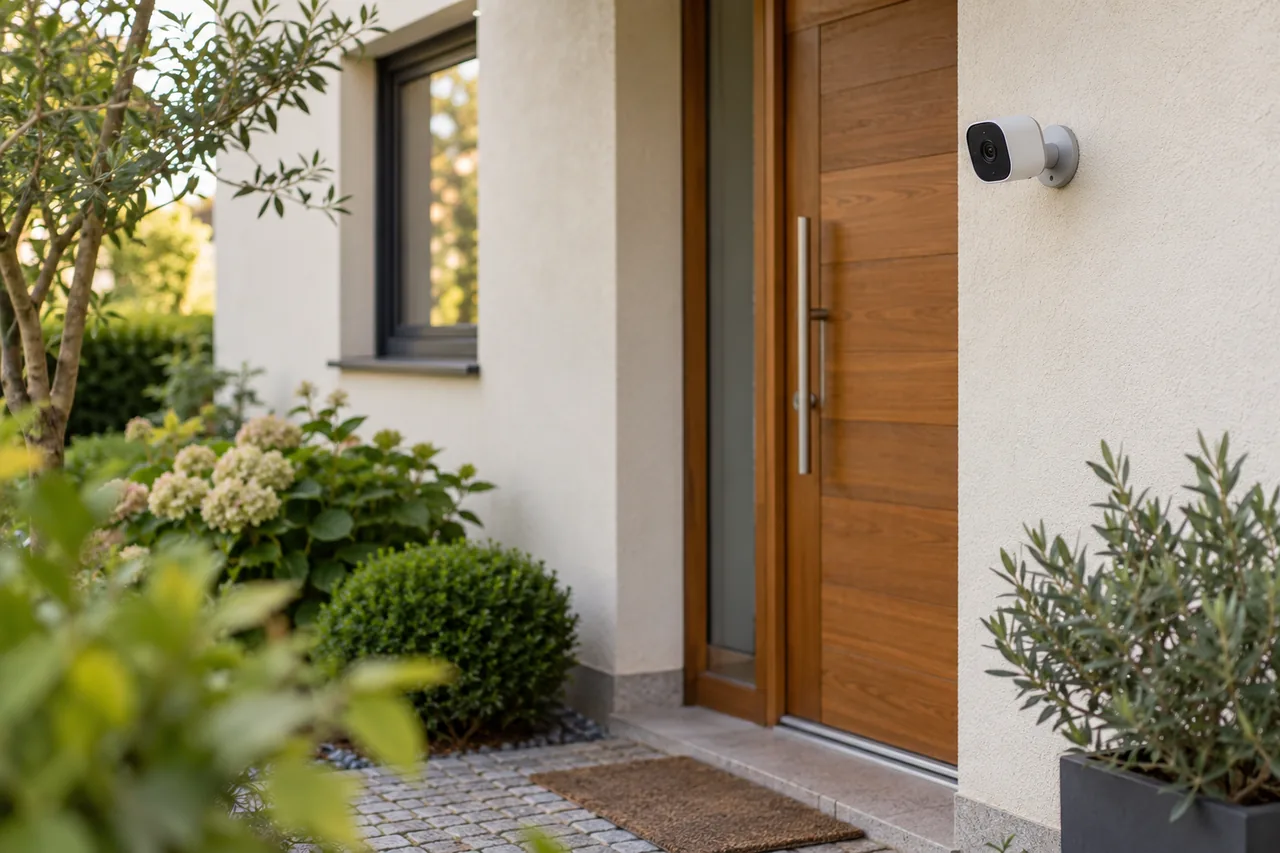
What may a camera on your house film?
Across Europe the starting point is similar: you may monitor your own property if you have a genuine reason, such as protection against burglary. The EU data protection rules (GDPR) do not apply to purely personal or household activities. But on 11 December 2014, under the directive that preceded the GDPR, the Court of Justice of the EU ruled in case C-212/13 (Ryneš) that a camera on a family home which covers public space, even partly, is no longer a purely household activity. Germany's DSK applies the same reasoning under the GDPR. From that point, the full set of obligations applies: a legitimate interest, short storage and information for the people filmed.
National authorities draw the line at the property boundary. Germany's Data Protection Conference (DSK) puts it plainly: the right to observe ends at your own boundary, and private individuals in residential areas may not monitor public space. France's CNIL allows filming inside your property, such as the garden or a private drive, but not the street, even to keep an eye on a car parked outside. Italy's Garante also excludes shared courtyards, landings and stairs. The country table below shows the details.
Switzerland is not in the EU, so the GDPR does not apply there; the Federal Act on Data Protection (FADP) does. The Federal Data Protection and Information Commissioner (FDPIC) says the recording area must be limited to your own property, and private individuals may generally not monitor public space, because order on the street is a matter for the police. You do not need a permit for a camera on your own property.
What about a video doorbell?
A doorbell camera almost always looks at the entrance and often at the pavement too. The German DSK describes a set-up that is unproblematic: the image is transmitted only when someone rings, nothing is stored permanently, the angle is no wider than a door viewer, and transmission stops automatically after a few seconds. The Swiss FDPIC accepts a doorbell camera that only activates when the button is pressed and has a relatively small angle.
Many devices do more: motion detection, live view from an app at any time, recording before the bell is pressed. If such a doorbell captures public space, it usually does not meet the legal requirements, according to the DSK. Spain's AEPD takes a functional view: a video entry system that only lets you check who is at the door and open it falls outside data protection law, while a digital peephole is covered once it processes personal data beyond what a traditional peephole does.
| Feature | Usually fine | Usually a problem |
|---|---|---|
| Trigger | Image only when someone rings | Motion detection set off by passers-by on the pavement |
| Angle | About as wide as a door viewer, aimed at the door | Wide angle reaching the street or next door's entrance |
| Storage | No permanent storage | Pre-recording before the ring, or continuous recording |
| Live view | Switches off by itself after a short time | Available in the app at any time, without anyone ringing |
What does this look like in practice?
Fictional example: Marta lives in a terraced house near Ghent and fits a video doorbell. The first live image shows her door, but also half the pavement and next door's front step. Motion alerts arrive every time someone walks a dog past, and short clips pile up in the app.
Marta changes three things. She turns off motion detection, so the doorbell only reacts when someone rings. She mounts it a little lower and angles it towards her door until the pavement and the neighbour's step are out of view. And she picks the shortest storage period the app offers. Then she shows her neighbour the live image. If she is unsure whether that is enough, she can ask her national data protection authority.
How do you set up a camera or doorbell with minimal data?
Menu names differ between manufacturers. These points apply to almost every device:
- Check the angle: Look at the live view while walking along your boundary. Anything beyond it should not be in the picture. The FDPIC also mentions a physical barrier to limit the camera's angle.
- Mask areas: Many apps can block out parts of the image. Austria's DSB suggests digital masking or pixelation, physical covers or limited operating times.
- Turn off sound: The DSK says an audio function on a surveillance camera should be irreversibly disabled. Recording private conversations can be a criminal offence, for example in Germany and Switzerland.
- Keep storage short: Germany's DSK and Austria's DSB treat 72 hours as a general benchmark; the Swiss FDPIC names 24 hours as the norm. Delete footage without watching it if nothing has happened.
- Limit access: Share the app only with people who really need it. The FDPIC says as few people as possible should have access to the images.
- Do not publish: Clips of couriers, passers-by or neighbours do not belong on social media or in group chats. The FDPIC requires the prior consent of the people shown. Footage of a crime goes to the police.
Tip: After setting up, save a dated screenshot of the live view. It shows what the camera covers and helps you notice if it later shifts.
A connected camera is also a device on your home network: Checking your home Wi-Fi explains what to look at. How smart home devices talk to each other is covered in Getting started with a smart home.
Do you need a sign?
If your camera falls under the GDPR, you must inform the people it films before they enter the monitored area. Austria's DSB asks for a clearly visible notice, ideally at eye level. Italy's Garante accepts a simplified sign such as the EDPB model, without revealing the camera's exact position. The German DSK adds that a sign does not make an unlawful camera lawful, and walking past it is not consent.
Inside your home, people from outside the family need to know too. The CNIL says carers or nannies must be told that cameras exist and why, for example by a notice at the entrance to the filmed area or in the employment contract. Italy's Garante adds that rooms such as bathrooms should be avoided.
A dummy camera processes no data, so data protection law does not apply. Even so, the DSK warns that a dummy can make people feel watched and lead to civil claims. Austria's DSB advises keeping the invoice so you can prove it is a dummy.
How do the rules differ across Europe?
Based on what the authorities publish as of October 2026.
| Country | Authority | Key points |
|---|---|---|
| Germany | Data protection authority of the federal state (Land) | Observation ends at the boundary; storage generally up to 72 hours; doorbell camera only with image after ringing |
| Austria | Datenschutzbehörde (DSB) | Pavement at most 50 cm, and only if the facade or fence cannot be protected otherwise; 72 hours as benchmark; no registration since 25 May 2018 |
| Switzerland | FDPIC; civil courts in disputes | FADP instead of GDPR; own property only; storage usually 24 hours; doorbell camera active only when rung |
| France | CNIL | Film only inside your property, not the street or neighbours; inform carers or nannies working in your home |
| Italy | Garante per la protezione dei dati personali | Only areas exclusively yours; no shared areas, neighbours or public passages; sign before entering the area |
| Spain | Agencia Española de Protección de Datos (AEPD) | Public highway only where essential; deletion within one month at most; visible sign at the entrances |
What can you do if a neighbour's camera points at you?
- Talk first: Many cameras are simply badly aligned. Ask the neighbour calmly to change the angle or position, or to delete recordings.
- Ask for information: In Switzerland, Article 25 FADP lets you ask whether footage of you exists, why, for how long and who can see it.
- Contact the authority: In France you can contact the CNIL's complaints service, the police or the gendarmerie. In Austria you can lodge a complaint with the DSB for breach of the right to confidentiality under section 1 of the Data Protection Act.
- Go to court if needed: In Switzerland a civil claim under Article 28 of the Civil Code and Article 32(2) FADP starts with a conciliation request; since 1 September 2023 no court fees are charged for these disputes, although this does not cover lawyers' fees. In Germany, the DSK points to civil claims to stop the surveillance if a camera reaches your property.
- Criminal law in narrow cases: France's CNIL refers to Article 226-1 of the Criminal Code on recording someone's image in a private place without their knowledge; Italy's Garante refers to Article 615-bis of the Criminal Code on unlawful interference in private life.
If a dispute gets stuck, individual legal advice helps. If you are the one taking photos of guests or neighbours, Sharing a group photo helps you ask before posting.
Common mistakes
- Estimating the angle while mounting the camera instead of checking the live view right to its edges.
- Leaving the doorbell's motion detection on although it picks up everyone on the pavement.
- Assuming that a sign makes any camera lawful.
- Sharing clips of a courier or passers-by in the neighbourhood group chat.
- Forgetting that the microphone is on because the setting was never checked.
Your checklist
The checkboxes are for your own reference. No entries are sent to us. To keep a copy, print the page or save it as a PDF using your browser menu.
Common questions
Can I film my own driveway and garden?
Yes, if the camera shows only your property and you have a genuine reason, such as burglary protection. The pavement, the street and neighbouring plots must stay out. Austria's DSB exceptionally tolerates up to 50 cm of pavement if the facade or fence cannot be protected otherwise. In France, the CNIL explicitly lists the garden and private drive as areas you may film.
Is it legal for a video doorbell to record people walking past?
Usually not, if it captures public space. The German DSK, Austria's DSB and the Swiss FDPIC describe a doorbell camera as unproblematic when it activates only when someone rings, has a narrow angle and switches off after a short time. Motion detection, pre-recording or a live view of the pavement that is available at any time generally do not meet these conditions.
How long can I keep recordings?
Only as long as you need them. In Germany and Austria, 72 hours is the general benchmark; the Swiss FDPIC names 24 hours as the norm. Italy's Garante calls 24 hours sufficient for a small shop and asks for stronger reasons beyond 72 hours. Spain allows up to one month. Longer periods need a reason, and footage without an incident should be deleted unwatched.
Sources and further information
Primary sources from public authorities, consumer organisations and providers. A source may be in another language; follow the guidance that applies to your service and where you live.
- Court of Justice of the EU: Judgment of 11 December 2014, C-212/13 (Ryneš)Source review date:
- German Data Protection Conference: Guidance on video surveillance by private bodies (in German)Source review date:
- Austrian Data Protection Authority: FAQ photo and video (in German)Source review date:
- FDPIC: Video Surveillance by Private IndividualsSource review date:
- FDPIC: Video Surveillance of Public Places by Private IndividualsSource review date:
- CNIL: Video surveillance at home (in French)Source review date:
- Italian Data Protection Authority (Garante): FAQ on video surveillance (in Italian)Source review date:
- Spanish Data Protection Agency (AEPD): Guide on the use of video cameras (in Spanish)Source review date: