How does the scam usually unfold?
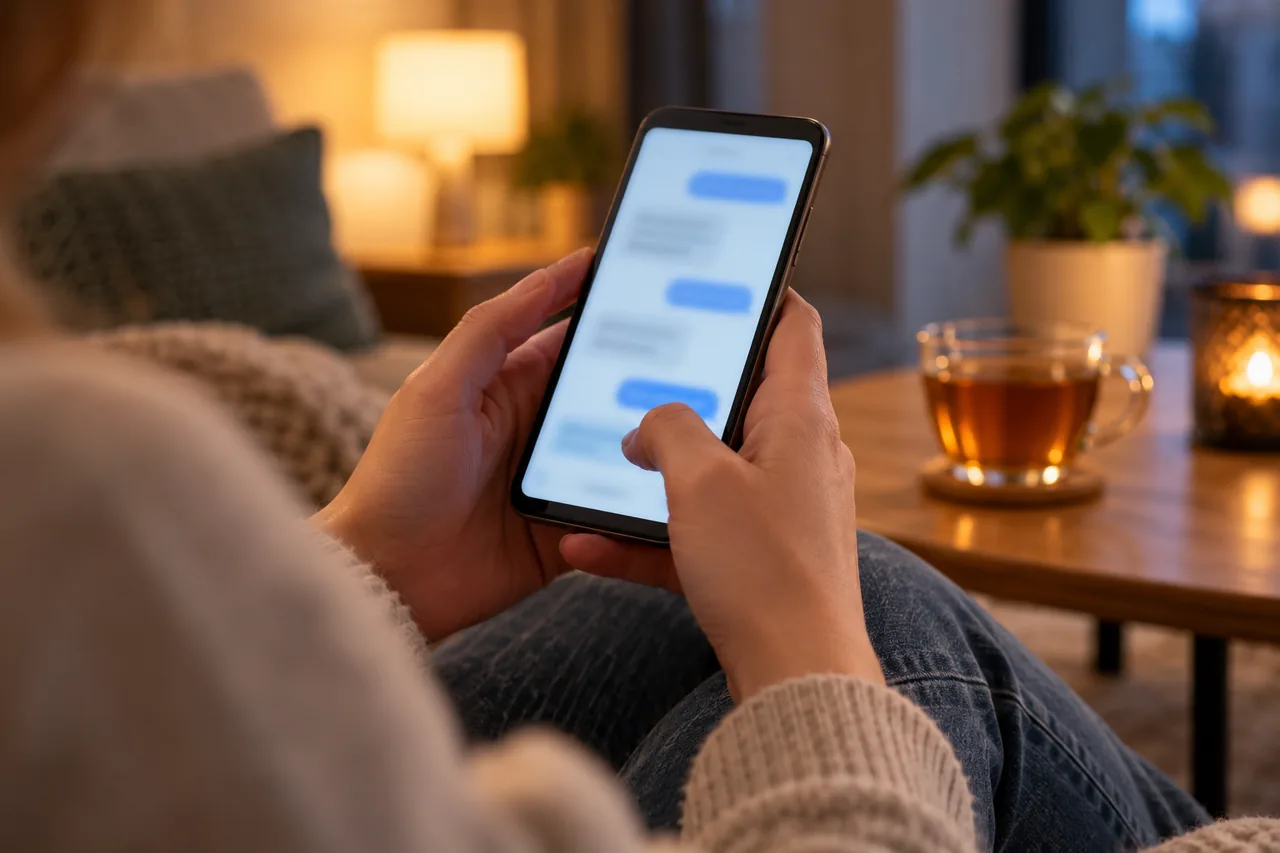
The European supervisory authorities call it a romance investment scam: someone you have never met in real life contacts you through social media, a dating app or by phone. They build trust through frequent, personal conversations, often using fake profiles with stolen or AI-generated photos. Only then does the talk turn to crypto investments with high returns and low risk.
| Stage | What happens | Your move |
|---|---|---|
| Getting to know you | Contact via a dating app, social network or phone; frequent, personal messages | Keep personal and financial details to yourself |
| Trust | They put their wealth down to crypto, gold or foreign currency | Do not base investment decisions on this contact |
| The platform | A specific, often unknown website or app you are told to use | Install nothing; check the provider yourself |
| First deposit | A small amount, apparent profits, sometimes a small test withdrawal | Do not treat displayed profits as proof |
| Pressure | Invest more; withdrawals only after paying supposed taxes or fees | Stop paying; contact your bank and the police |
| Aftermath | Fake authorities offer to recover your money for a fee | Ignore them and pay nothing |
What are the warning signs?
A single sign does not prove fraud. When several come together, pause.
In the relationship
- Strong feelings declared very early, although you have only just met.
- They avoid meeting in person or on video; the Banca d'Italia notes that video calls can be faked with AI.
- They ask you to move the conversation to a different messaging app.
- They ask you not to tell family or friends about the investment.
In the offer
- High returns with little or no risk, and pressure to act immediately.
- A specific, often unknown app or platform that you are told to use.
- Payment in crypto, by gift card or by transfer to an account with no recognisable link to the provider.
- Requests for your private keys or seed phrase, or to download apps.
- Withdrawals that are blocked or allowed only after you pay taxes or fees.
Tip: Talk to someone you trust before you invest. The Banca d'Italia asks families to listen out when a relative mentions a new online relationship or a first crypto investment.
How can you check the provider?
Never check through links or numbers from the chat. The European supervisory authorities recommend verifying the company independently and looking at:
- the ESMA register, to see whether a provider is authorised in the EU;
- your national financial supervisor's website, for warnings and blacklists;
- the IOSCO I-SCAN list.
A missing warning does not make a provider legitimate: BaFin stresses that warning lists can never be complete. To rule out identity misuse, contact a named firm only through details you have looked up yourself in an official register.
How do you end the contact safely?
You do not have to unmask the person or explain anything. The order matters.
- Save the chat, profile details, screenshots of the platform, emails and transaction numbers.
- Stop all transactions, including any 'fee' for a withdrawal.
- End all contact and block the person.
- If you shared login details, change the passwords on all your accounts.
- If you allowed remote access, follow Unknown remote access allowed: end the connection and get help.
Expect a reaction: reproaches, new promises or more pressure. You do not need to reply.
Already sent money: what now?
Call your bank straight away and report the scam to the police. Crypto transactions usually cannot be reversed, but your crypto provider may be able to freeze the scammer's account. First steps in detail: Sent money to a scammer: first steps with your bank and police.
| Country | Financial supervisor | Report | Worth knowing |
|---|---|---|---|
| Germany | BaFin (company database, warnings) | Police | A licence from another EEA supervisor also counts |
| Austria | Financial Market Authority (FMA) | Police; Watchlist Internet and the FMA | Beware follow-up scams by fake lawyers or Interpol |
| Switzerland | FINMA | Cantonal police | Not in the EU; use only FINMA-authorised firms |
| France | AMF (white lists and blacklists) | File a complaint; Info Escroqueries on 0 805 805 817 | AMF Epargne Info Service: 01 53 45 62 00 |
| Italy | Consob, Banca d'Italia | Carabinieri or Polizia postale (commissariatodips.it) | Never pay to recover an investment or unlock funds |
| Spain | CNMV | Policía, Guardia Civil or the courts; INCIBE helpline 017 | 017: free, confidential, daily 8:00–23:00 |
Beware of the second scam
Fraudsters may later pose as police, tax or financial authorities and offer to recover the money for a fee. The European supervisors warn that this is typically another scam. More in Recovery offers after a scam: spotting the second risk.
An example: Aoife and the friendly engineer
Fictional example: Aoife from Galway meets a man on a dating app who says he works as an engineer abroad. After three weeks of daily messages he mentions his crypto trading profits, sends a platform link and offers to help via remote access.
Aoife deposits EUR 250; the next day the platform shows a 40% gain. When he urges her to add EUR 8,000, she looks the platform up in the ESMA register and finds nothing.
She saves the chat, blocks him and, with her sister, reports the case to the police. The EUR 250 is probably lost; the EUR 8,000 is not.
Common mistakes
- Treating the profits shown on the platform as real money.
- Seeing a small test withdrawal as proof that the platform is genuine.
- Paying 'just one more' tax or fee to release a withdrawal.
- Granting remote access or sharing ID copies, seed phrases or banking logins.
- Staying silent out of embarrassment instead of telling your bank, the police and someone you trust.
Your checklist
The checkboxes are for your own reference. No entries are sent to us. To keep a copy, print the page or save it as a PDF using your browser menu.
Common questions
Is every online contact who talks about money a scammer?
No. It becomes risky when the person steers you to a specific platform or app, promises high returns at low risk, pushes you to act fast or wants to help you set things up. Citing a warning from IOSCO, the Banca d'Italia advises against making investment decisions based on such contacts and recommends researching any offer thoroughly.
The platform shows profits. Can't I just withdraw everything?
If the platform asks for taxes, fees or other payments before releasing your money, that is a typical sign of this scam, according to BaFin and the Banca d'Italia. BaFin adds that the profits shown are fake and no real trading takes place. Pay nothing more and go to your bank and the police.
What applies in Switzerland?
Switzerland is not in the EU and has its own supervisor, FINMA. The Swiss National Cyber Security Centre advises investing only through FINMA-authorised firms and being very wary of unsolicited help after a scam. Report financial losses to the cantonal police: reports make investigations possible, even though most lost money is not recovered.
Sources and further information
Primary sources from public authorities, consumer organisations and providers. A source may be in another language; follow the guidance that applies to your service and where you live.
- EBA, EIOPA and ESMA: Crypto frauds and scams, stay alert and protect yourselfSource review date:
- BaFin: Investment fraud via WhatsApp and Telegram (German)Source review date:
- Watchlist Internet: What to do after investment fraud (German)Source review date:
- Swiss National Cyber Security Centre: Investment scams and fake recovery offersSource review date:
- AMF Protect Epargne: FAQ on scams (French)Source review date:
- Banca d'Italia: How to protect yourself from romance investment scams (Italian)Source review date:
- CNMV: Ten tips to avoid unauthorised investment firms (Spanish)Source review date:
- INCIBE: Cybersecurity helpline 017 (Spanish)Source review date: