An example: the armchair that looked too good
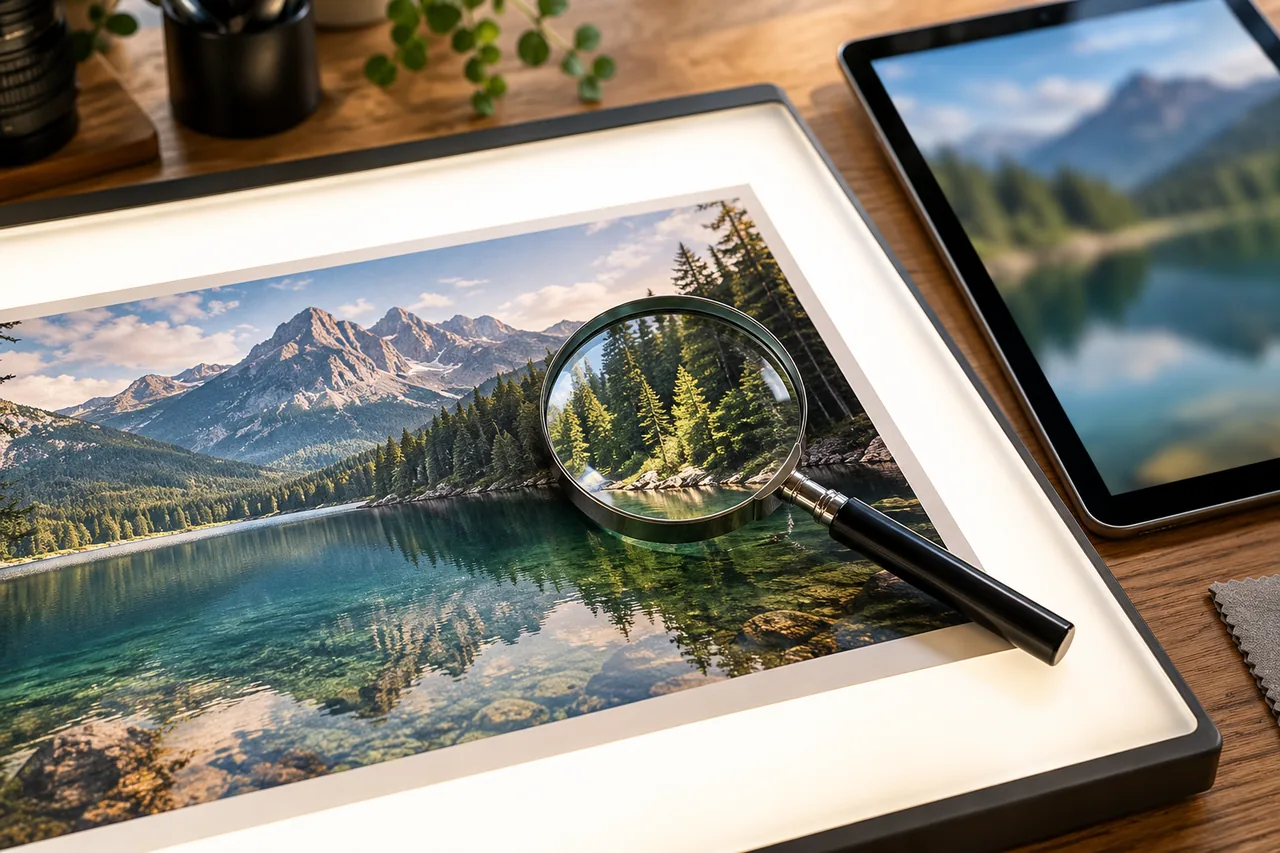
Fictional example: Ciara in Cork finds a velvet armchair for €120 on a classified ads site. The photo looks like a catalogue shot, but the rug pattern behind the chair stops abruptly and the shadow does not match the window light.
Via the platform, she asks for the seller’s own photos: the back, the armrest close up and a note with her first name. The seller says the picture is just an example. His real photos show a worn armrest. Ciara views the chair, negotiates the price down and pays in cash on collection.
How can you spot an AI-generated or edited product photo?
Germany’s Federal Office for Information Security (BSI) describes clues that can give away AI images and names fake shops as one area of misuse. For product photos, these help most:
| Clue | What to look for | Example in a listing |
|---|---|---|
| Light and shadow | Shadows not matching the light source, missing or wrong reflections | A kettle reflects a room that is not in the picture |
| Patterns | Patterns that break off or continue differently behind objects | Blanket checks that do not line up either side of the armrest |
| Lettering | Faulty, blurred or meaningless letters | A label with made-up writing |
| Perspective and physics | Lines without a common vanishing point, floating parts | A table leg not touching the floor |
| Details and realism | Distorted jewellery, a conspicuously blurred background, an unlikely scene | A used chair without a single mark, in studio light |
No clue is proof: according to the BSI, AI detectors do not guarantee reliable detection, and no known method reliably detects many image generators. Not every flawless image is AI, and a stock photo does not show the condition of the actual item either. So check whether original photos are posted at all.
What does the context of the listing tell you?
The context often says more than the picture. The BSI recommends a reverse image search, which shows where the same photo appears elsewhere. If it turns up in many shops or in an ad from another city, it is unlikely to show the item on offer. What provenance data such as Content Credentials can tell you is covered in Understanding AI labels.
Austria’s Watchlist Internet warns about shops that use German or Austrian town names to look like local retailers but ship from Asia, often sending poor-quality goods. Returns are often impossible or very expensive.
- Compare the returns address with the legal notice: with such shops, Watchlist Internet notes, they do not always match.
- More checks: Unknown fashion shop: seven checks before your first order.
How do you get real photos from the seller?
With classified ads, asking for the seller’s own photos is the simplest check. Phrase it so that a catalogue or AI image will not do.
- Write via the platform. If the seller wants to switch to a messenger app or email, read When a sale is moved off the marketplace.
- Specify angles and details: the back, the label, existing scratches.
- Ask for a note with your first name and the date in the picture, or a short all-round video.
- Get the condition and key features confirmed in writing.
- If possible, view the item and pay only on collection.
Sample message
‘Hello, could you send me two photos of your own, of the back and the label, with a note showing [your first name] and today’s date? Are there any scratches, stains or repairs? Thanks.’
Tip: If the seller sticks to the same flawless images or pushes for payment, that is an answer too. You need not prove a fake to walk away.
What are your rights if the item looks different?
It depends on who you buy from. According to the EU portal Your Europe, goods should match what was advertised or agreed. If not, a trader must repair or replace them free of charge or give a price reduction or full refund. You always have a 2-year minimum guarantee and can cancel online purchases within 14 days, with some exceptions.
Second-hand goods from private individuals are not covered by EU consumer rules, so online marketplaces must indicate whether a seller is a trader. National law governs private sales; in France, for instance, a private seller is only liable for hidden defects. Avoid paying in advance, as explained in Buying second-hand: five questions before paying in advance.
Do sellers have to label AI images?
Article 50 of the EU AI Act applies from 2 August 2026. A deepfake can also be an AI image that resembles an existing object and would falsely appear authentic. Anyone using such content, other than for purely personal, non-professional purposes, must disclose it. Whether a given product photo is covered depends on the case, so a missing label proves nothing.
This guide is not legal advice. For disputes with traders in another EU country, the European Consumer Centres Network (ECC-Net) can help.
Where can you get help in your country?
EU consumer rules apply across the EU; private sales follow national law. Switzerland is not an EU member and has its own rules.
| Country | Key point | Where to turn |
|---|---|---|
| Germany | Private sellers may exclude liability, but not if they conceal damage or give false information | Verbraucherzentralen (consumer advice centres) |
| Austria | EU rules | Watchlist Internet: report form, Fake-Shop Detector |
| Switzerland | No general right of withdrawal online; 2-year warranty, used goods at least 1 year | Stiftung für Konsumentenschutz, FRC, ACSI |
| France | Private sellers liable for hidden defects only, 2 years from discovery | SignalConso (problems with traders), a mediator |
| Italy | 14-day withdrawal, one year if you were not informed | AGCM: freephone 800.166.661 (Mon–Fri, 10:00–14:00) |
| Spain | Legal guarantee of 3 years since 1 January 2022; for used goods it can be shortened by agreement, to no less than 1 year | INCIBE cybersecurity helpline 017 |
In Switzerland, the State Secretariat for Economic Affairs (SECO) advises reporting a defect to the seller immediately, preferably in writing. You can then cancel, reduce the price or ask for a replacement.
Common mistakes
- Taking a flawless image as proof that a used item is like new.
- Relying on an AI detector.
- Accepting a stock photo instead of asking for original photos.
- Moving to a messenger app for photos and paying in advance there.
- Expecting a private seller to accept returns like a shop.
Your checklist
The checkboxes are for your own reference. No entries are sent to us. To keep a copy, print the page or save it as a PDF using your browser menu.
Common questions
Can I reliably tell whether a picture was made by AI?
Not always. Mismatched shadows, broken patterns or faulty lettering are clues, but good AI images often show none, and the BSI notes that AI detectors do not guarantee reliable detection. So rely on what you can verify: the seller’s own photos, a viewing and a protected way to pay.
What if the seller will not send real photos?
Then the most important check is missing, and you can walk away without explaining why. If collection is possible, look at the item in person and pay only then. Never pay in advance for something you only know from flawless pictures.
The item looks completely different from the picture. What now?
Contact the seller in writing and save the listing and messages. A trader in the EU owes you repair, replacement, a price reduction or a refund, and online purchases can usually be cancelled within 14 days. Private sellers owe you less. For your case, ask a consumer organisation.
Sources and further information
Primary sources from public authorities, consumer organisations and providers. A source may be in another language; follow the guidance that applies to your service and where you live.
- Your Europe (EU): Your rights when shopping in the EUSource review date:
- European Commission: Transparency obligations under Article 50 of the AI ActSource review date:
- BSI (Germany): Recognising AI-generated images (in German)Source review date:
- Verbraucherzentrale Hamburg: Buying second-hand goods (in German)Source review date:
- Watchlist Internet (Austria): Misleading ads from problematic online shops (in German)Source review date:
- SECO (Switzerland): Problems after a purchase (in German)Source review date:
- French Ministry of the Economy: Guarantees for second-hand and refurbished goods (in French)Source review date:
- AGCM (Italy): Ten rules for online shopping (in Italian)Source review date:
- INCIBE (Spain): Detecting fraud with reverse image search (in Spanish)Source review date:
- European Consumer Centre Spain: Spain extends the minimum legal guarantee from two to three years (in Spanish)Source review date: