How much does a smart thermostat really save?
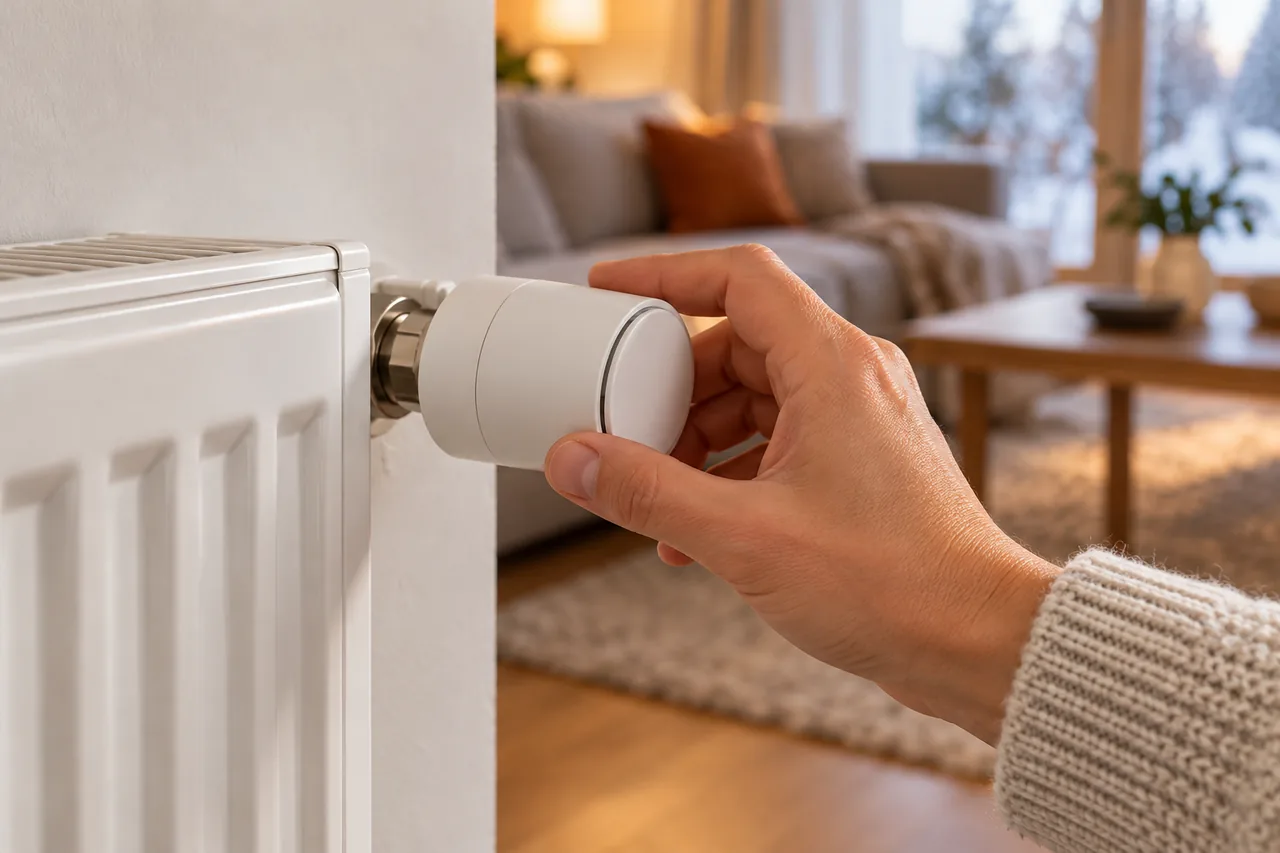
Room temperature is the biggest lever: each degree lower saves about 6 per cent of energy, according to the German consumer centre (Verbraucherzentrale). A smart thermostat applies this automatically, for example at night or while nobody is at home.
How much you gain depends on your habits so far. The Verbraucherzentrale estimates that lowering the temperature during absences saves between 2 and 8 per cent of heating costs, depending on previous behaviour. If you have always turned the radiators down yourself, you mainly gain comfort. Lowering the temperature pays off most in poorly insulated buildings; in very well insulated ones the saving is small. Treat manufacturers' maximum figures with caution.
A quick calculation
If you pay €900 a year for heating, 2 to 8 per cent is roughly €18 to €72. Compare that with the hardware: in Germany, programmable thermostats start at about €10, smart home thermostats at about €40 and a window sensor at about €25, according to the Verbraucherzentrale. Batteries usually need replacing every one to two years.
Connected extras use electricity too: a separate control panel in every room can even increase total energy use, the Verbraucherzentrale notes.
Radiator valve, timer or app: which option suits you?
The table compares the usual options by how they save and where data is created.
| Option | How it saves | Where data is created | Suits you if |
|---|---|---|---|
| Standard thermostatic valve | You turn it down half a step to a full step at night and when you go out | Nowhere, no connection | you lower the heating by hand consistently |
| Programmable thermostat without app | Fixed time programmes lower the temperature automatically | Only in the device | your routine is regular |
| Smart thermostat with a hub at home | Time programmes, window sensors, control via a hub (gateway) | In the hub; whether a cloud is also involved depends on the system | you want to coordinate several rooms |
| Smart thermostat with manufacturer app | As above, plus remote control while you are away | Often in the manufacturer's cloud, with an account | your hours at home vary |
Models with automatic open-window detection work rigidly, the Verbraucherzentrale says: the heating may pause for around 20 minutes even if you closed the window after 5. A separate window sensor reliably detects when windows or doors open and close.
Questions to ask yourself before buying
- Do you already turn the heating down at night and when you leave? Then the extra saving is small.
- How well is your building insulated? The worse it is, the more lowering pays off.
- Is your daily routine regular? Then a time programme without an app is often enough.
- Are you willing to create a manufacturer account and share your location?
Which wireless standards and hubs work together is explained in Getting started with a smart home: what Matter and wireless standards offer.
What does heating data reveal about your daily life?
Consumption and switching times allow conclusions about your habits and about when residents are at home or away, the Verbraucherzentrale warns. Most smart home devices stay connected to the internet and often store data in a cloud, sometimes processed by third parties as well.
Some apps ask for your location, for instance to lower the heating when you leave. The Verbraucherzentrale advises choosing privacy-friendly app settings and switching location tracking off when it is not needed.
Questions for the manufacturer
- Which data is collected, and is it stored in a cloud?
- Do you need an account, and is two-step login available?
- How long will security updates be provided?
- Can the heating still be controlled without an internet connection?
Since 12 September 2025 the EU Data Act has applied. According to the European Commission, it lets users of connected products, including smart home devices, access the data they generate and share it with a third party of their choice. Data holders must tell you what type of data the product will generate, including its volume and how often it is collected.
Change any default password straight away and install updates promptly. Your thermostat or hub sits on your home network; Checking your home Wi-Fi: five questions for your router shows how to secure it.
Smart meters: what is measured and who sees it?
In Germany and Switzerland, smart meters record your electricity use in 15-minute intervals and usually send the readings once a day. EU rules give you a baseline: according to the EU portal Your Europe, you are entitled to free access to your consumption data. With a smart meter you should be able to see detailed information on your own consumption for at least the two previous years, free of charge. You can also ask the data manager, such as your supplier or grid operator, to give other electricity or gas suppliers access, at no cost to you.
Germany shows how the rules work in detail. There, the intelligent metering system sends 15-minute values once a day to the meter operator. The grid operator and supplier may receive only what is needed for the contract or legal duties; more detailed data flows only if you expressly agree to it in your supply contract, the Verbraucherzentrale explains.
Does the meter itself save money?
Not automatically. In Germany, the Verbraucherzentrale sees a direct financial benefit only in combination with a dynamic electricity price contract, where the price follows the power exchange. Every supplier there has had to offer one since 2025. Such contracts mainly pay off if you can shift a lot of consumption, for example with a heat pump or a wall charger for an electric car, and you carry the full price risk.
What applies in your country?
Smart meter rules are national. Switzerland is not in the EU, so the Data Act and EU energy market rules do not apply there automatically; it has its own rules.
| Country | Meter and data | Your say | Where to check |
|---|---|---|---|
| Germany | Mandatory above 6,000 kWh a year, for solar systems above 7 kW and for heat pumps or wall chargers; 15-minute values sent daily | You cannot refuse installation; data beyond contract and legal duties only with consent | Bundesnetzagentur, Verbraucherzentrale |
| Austria | Smart meters record all 15-minute values by default under the Electricity Industry Act (ElWG); with low annual use, sending only daily values is allowed for a transition period | Households can object to daily and 15-minute values being stored and transmitted, except e.g. with a dynamic tariff, heat pump, charging point or own generation; meter readings and monthly values are still sent | E-Control |
| Switzerland | Grid operators must replace at least 80 per cent of old meters by the end of 2027; 15-minute load profile, usually sent once a day | Installation cannot normally be refused; the data belongs to you and you decide who besides the grid operator may access it | ElCom |
| France | Linky: Enedis records meter readings daily | Half-hourly load curve collected only with your consent; passing detailed data to suppliers or third parties also needs consent, managed in your Enedis account | CNIL, Enedis |
| Italy | Second-generation smart meter (Open Meter 2G) installed by e-distribuzione | The Chain 2 function lets a certified home device show your consumption in real time | e-distribuzione |
| Spain | The SIPS database holds technical and consumption data for each supply point; for electricity it does not identify the account holder | You can object to your supply point data being shared with authorised retailers, via your distributor or the CNMC | CNMC |
In Switzerland a smart meter costs around CHF 250 including installation, according to the electricity regulator ElCom; the grid operator bills it to customers through the metering tariff. A grid operator may accept a refusal within the remaining 20 per cent of meters, but you then pay the extra cost of manual reading. ElCom does not regard recurring charges of CHF 90 to 120 a year as inappropriate.
An example: Oliver sets up heating and data in Munich
Fictitious example: Oliver, a British researcher, rents a flat in Munich. He works irregular hours in a lab, yet the heating ran evenly all day. His last bill shows €780 a year for heating. Using the Verbraucherzentrale range of 2 to 8 per cent, he expects to save about €16 to €62.
He buys smart thermostats for the living room and study and keeps the old heads in a labelled box for when he moves out. During setup he declines location access, sets time programmes instead and turns on two-step login for the manufacturer account.
His electricity meter is a modern digital meter that sends no data, so nothing changes there. A letter from a competing meter operator offers an upgrade; Oliver reads that such prices are not capped and decides to wait. He adds the thermostats to his list from Which devices belong to your digital household?.
Common mistakes
- Relying on the manufacturer's savings figure instead of your own heating habits.
- Letting unused rooms go cold: below 16 °C there is a risk of mould, the Verbraucherzentrale warns.
- Allowing the app permanent location access when a time programme would do.
- Taking a dynamic electricity price contract without being able to shift consumption to cheaper hours.
Your checklist
The checkboxes are for your own reference. No entries are sent to us. To keep a copy, print the page or save it as a PDF using your browser menu.
Common questions
Is a smart thermostat worth it in a rented flat?
Often, if you rarely turned the heating down before and your hours at home vary. In Germany, the Verbraucherzentrale says tenants may replace thermostat heads themselves but should keep the old ones to restore the original state when moving out. Rules differ between countries and tenancy agreements, so check yours first.
Can I refuse a smart meter?
It depends on the country. In Germany you cannot object to installation. In Switzerland the grid operator is obliged to install one but may accept a refusal within the remaining 20 per cent, and you then pay for manual reading. In Austria, households can object under section 54 of the ElWG to daily and 15-minute values being stored and sent, unless they have, for example, a dynamic tariff or a heat pump.
Can my electricity supplier see when I am at home?
Usually not in detail without your consent. In Germany the supplier receives only what the contract and legal duties require. In France, Enedis collects half-hourly data and passes it to suppliers only with your consent. In Switzerland the data belongs to you and you decide who besides the grid operator may access it.
Which temperature should I set?
Set the thermostat to the room temperature you actually want: a higher setting does not heat the room faster, the Verbraucherzentrale explains. At night and when you go out, turn it down by half a step to a full step. Do not let unused rooms fall below 16 °C because of the risk of mould. Each degree lower saves roughly 6 per cent of energy.
Can I get my thermostat data from the manufacturer?
In the EU, yes. Since 12 September 2025 the Data Act lets users of connected products access the data they generate and have it shared with a third party of their choice, according to the European Commission. In Switzerland, the Data Act does not apply automatically, as it is EU law.
Sources and further information
Primary sources from public authorities, consumer organisations and providers. A source may be in another language; follow the guidance that applies to your service and where you live.
- Your Europe (EU): Contracts and energy consumptionSource review date:
- European Commission: Data Act explainedSource review date:
- Verbraucherzentrale (Germany): Smart home (German)Source review date:
- Verbraucherzentrale (Germany): Setting and replacing thermostats (German)Source review date:
- Verbraucherzentrale (Germany): Smart meters, what you need to know (German)Source review date:
- Enedis (France): Personal data (French)Source review date:
- ElCom (Switzerland): FAQ on smart meters (French)Source review date:
- RIS (Austria): Electricity Industry Act (ElWG), section 54 (German)Source review date:
- e-distribuzione (Italy): Chain 2 (Italian)Source review date:
- CNMC (Spain): Supply Point Information System (SIPS) (Spanish)Source review date: