When may you record with smart glasses?
The General Data Protection Regulation (GDPR) does not cover purely personal or household activities. In a statement on smart glasses adopted on 13 October 2026, the European Data Protection Board (EDPB), where Europe's data protection authorities work together, gives examples: sharing a photo or video only with a family member or a friend, or using the glasses privately for translation.
This household exemption must be read narrowly. It ends once you share footage on a public social media account or use the glasses for work or politics. You then become responsible for the data, with duties such as transparency towards the people you film. Even where the GDPR does not apply, criminal, civil or employment law may.
Some authorities go further. The Hamburg Commissioner for Data Protection examined the first-generation Ray-Ban Meta Wayfarer as an example and reported on 10 September 2026: recording people outside a close circle of friends and family is generally not permitted, apart from rare cases of legitimate interest. Austria's data protection authority says the household exemption will regularly not apply when smart glasses are used in public.
Why are camera glasses more sensitive than a phone?
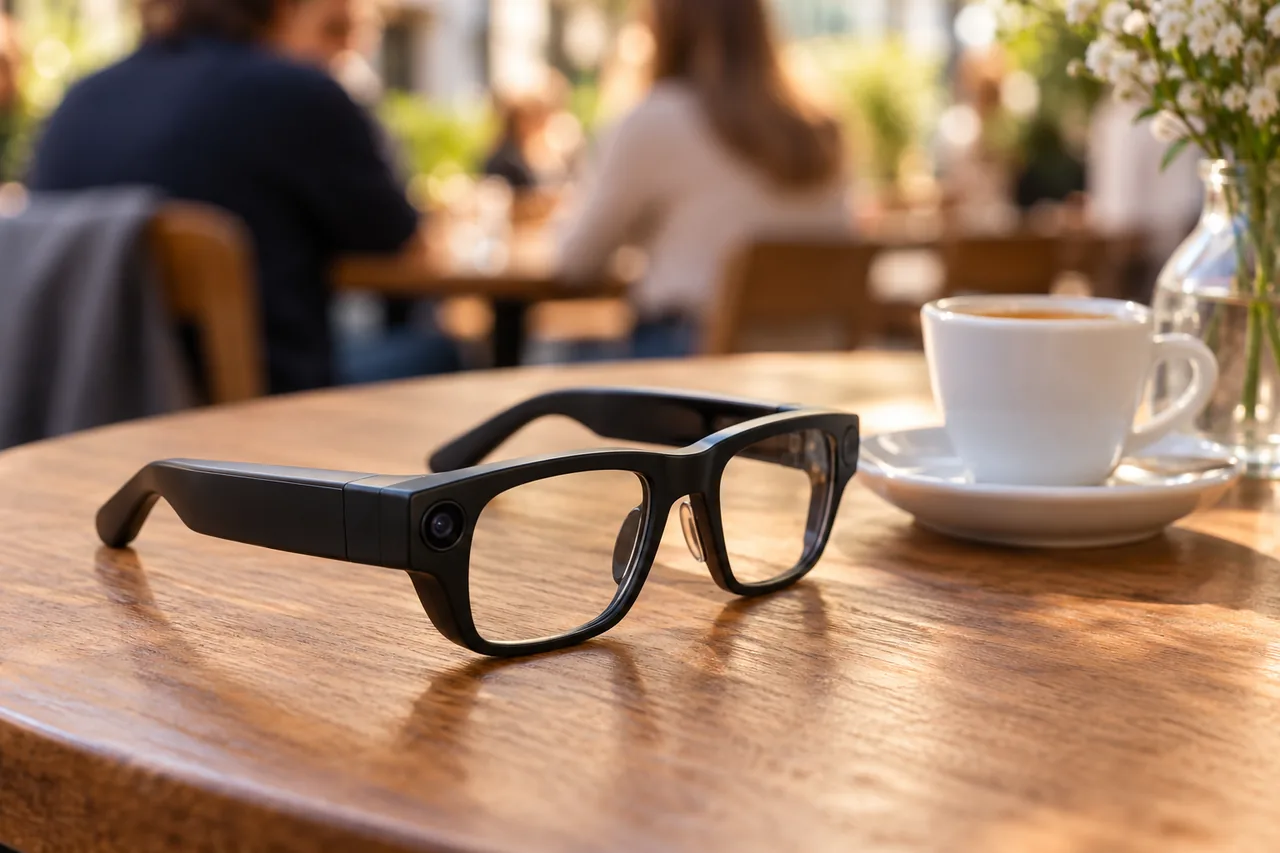
Glasses record from eye level without any visible gesture. The EDPB describes a near invisible collection of data, because the devices are hard to tell apart from regular eyewear.
On the model tested in Hamburg, a small light on the frame shows that the camera is running. The report found it hard to see in many settings, especially in sunlight, and not enough on its own to inform people. The microphones picked up sound from up to two metres away. If footage of others ends up in the provider's AI training, the Hamburg authority considers you jointly responsible.
Where should the camera stay off?
| Situation | What applies | What you do |
|---|---|---|
| Family birthday, everyone knows | Purely private: no GDPR while you share only with family or friends (EDPB) | Ask anyway, do not post publicly |
| Street, café, bus or train | Recording bystanders generally not permitted (Hamburg report) | Camera off; music or translation only |
| Conversation at the next table | Spain's AEPD advises against recording others' conversations without their knowledge | Never record other people's conversations |
| Changing rooms, toilets, pools, beaches, medical facilities, schools | The EDPB names these as particularly sensitive | No recording at all |
| Public social media post | No household exemption; you become a controller under the GDPR | Ask first, or blur people |
These are general rules; individual cases may differ. Cameras fixed to your home follow other rules, see Video doorbell and home CCTV: what you may film in Europe.
How can you wear smart glasses considerately?
The EDPB advises users to tell people explicitly when they use smart glasses and to respect their privacy and dignity. In practice:
- Say so before you record. The light is no substitute for words.
- Switch off the camera and microphone when you do not need them.
- Never cover the light. According to the EDPB, recording should not be possible when the indicator is covered.
- Do not record continuously ‘for safety’; the EDPB says general safety concerns do not justify it.
- Delete a recording straight away if someone asks you to.
The EDPB considers children particularly vulnerable. How to ask before sharing is covered in Sharing a group photo: ask before making it public.
What can you ask for if someone films you?
If you feel comfortable, ask the person to stop and delete the recording, as the Hamburg authority suggests. At a pool, call the staff on duty; if you feel threatened, contact the police.
Once a video is posted publicly, the household exemption no longer applies. You can ask for erasure if the processing is unlawful, and you can object. Report the post to the platform as well. If that fails, complain to your national data protection authority; according to the European Commission, it informs you of the progress or outcome within three months.
Report footage from a home, changing room or toilet to the police. For saving evidence and getting material removed, see Deepfake of you online: save evidence, report it, get it removed. For a legal dispute, seek individual legal advice.
What applies in each country?
| Country | Legal framework | Where to turn | Notable point |
|---|---|---|---|
| Germany | GDPR; right to one's own image (KUG); criminal law | Data protection authority, e.g. Hamburg; police | Recording bystanders generally not permitted |
| Austria | GDPR, national data protection act; image protection (Section 78 Copyright Act) | Datenschutzbehörde | Household exemption regularly not applicable in public |
| Switzerland | Swiss law, not the GDPR; Arts 179bis to 179quater Criminal Code | FDPIC (information); civil courts; police | Inform third parties and ensure they consent |
| France | GDPR; Article 9 Civil Code; Article 226-1 Criminal Code | CNIL | Up to one year in prison and a €45,000 fine for images taken in a private place without consent |
| Italy | GDPR and national law | Garante per la protezione dei dati personali | Special protection for minors |
| Spain | GDPR and national law | AEPD; Canal prioritario for sexual or violent content | No indiscriminate, mass or continuous filming in public |
In Switzerland, the Federal Data Protection and Information Commissioner (FDPIC) warns that smart glasses can record people without their knowledge; users who do not inform them and obtain consent risk civil and criminal consequences.
An example: Aoife explains her glasses
Fictional example: Aoife from Cork uses camera glasses mainly for music and translating menus. In a café in Lisbon, a man at the next table asks uneasily whether she is filming him.
Aoife explains, takes the glasses off and switches the camera off. Had she been filming, he could have asked her to delete the clip. That evening she films her sister's birthday, tells everyone first, shares the clip only in the family chat and keeps a friend's children out of the shot.
Common mistakes
- Treating the recording light as sufficient warning, although it is often hard to see outdoors.
- Posting family videos publicly later without asking again.
- Leaving the camera on in changing rooms, pools or clinics.
- Recording conversations just because the microphones are on anyway.
Your checklist
The checkboxes are for your own reference. No entries are sent to us. To keep a copy, print the page or save it as a PDF using your browser menu.
Common questions
Can I film in public with smart glasses?
Private recordings of family and friends fall outside the GDPR. Recording bystanders is different: the Hamburg authority considers it generally not permitted, because informed consent can hardly be obtained in practice. If someone ends up in your footage by chance, delete it on request and do not publish it.
How can I tell whether someone is filming me with glasses?
Often you cannot be sure. The model tested in Hamburg signals recording with a small light that is hard to see, especially outdoors. The EDPB notes that a white light can be mistaken for a reflection. If unsure, ask politely; someone who is not recording can show it by taking the glasses off.
Are my recordings used to train AI?
It depends on the device and settings. On the model tested in Hamburg, setup asks whether voice recordings may be stored for AI training. According to the report, withdrawing consent later only works for the future and does not delete stored recordings. Check the app's privacy settings straight away and delete histories you no longer need.
Sources and further information
Primary sources from public authorities, consumer organisations and providers. A source may be in another language; follow the guidance that applies to your service and where you live.
- European Data Protection Board: Statement on smart glasses, 13 October 2026Source review date:
- European Commission: Data protection, information for individualsSource review date:
- Hamburg Commissioner for Data Protection: Final report on the Ray-Ban Meta AI Glasses, 10 September 2026 (in German)Source review date:
- Hamburg Commissioner for Data Protection: Privacy also applies at the swimming pool (in German)Source review date:
- Austrian Data Protection Authority: FAQ photo and video (in German)Source review date:
- FDPIC: Wearables: smartwatches, fitness trackers, smart glassesSource review date:
- CNIL: Smart glasses, the CNIL calls for vigilance (in French)Source review date:
- Garante per la protezione dei dati personali: Smart glasses press release, 14 October 2026 (in Italian)Source review date:
- AEPD: Good practice for using smart sunglasses (in Spanish)Source review date:
- AEPD: Requesting removal of sexual or violent content via the Canal prioritario (in Spanish)Source review date: