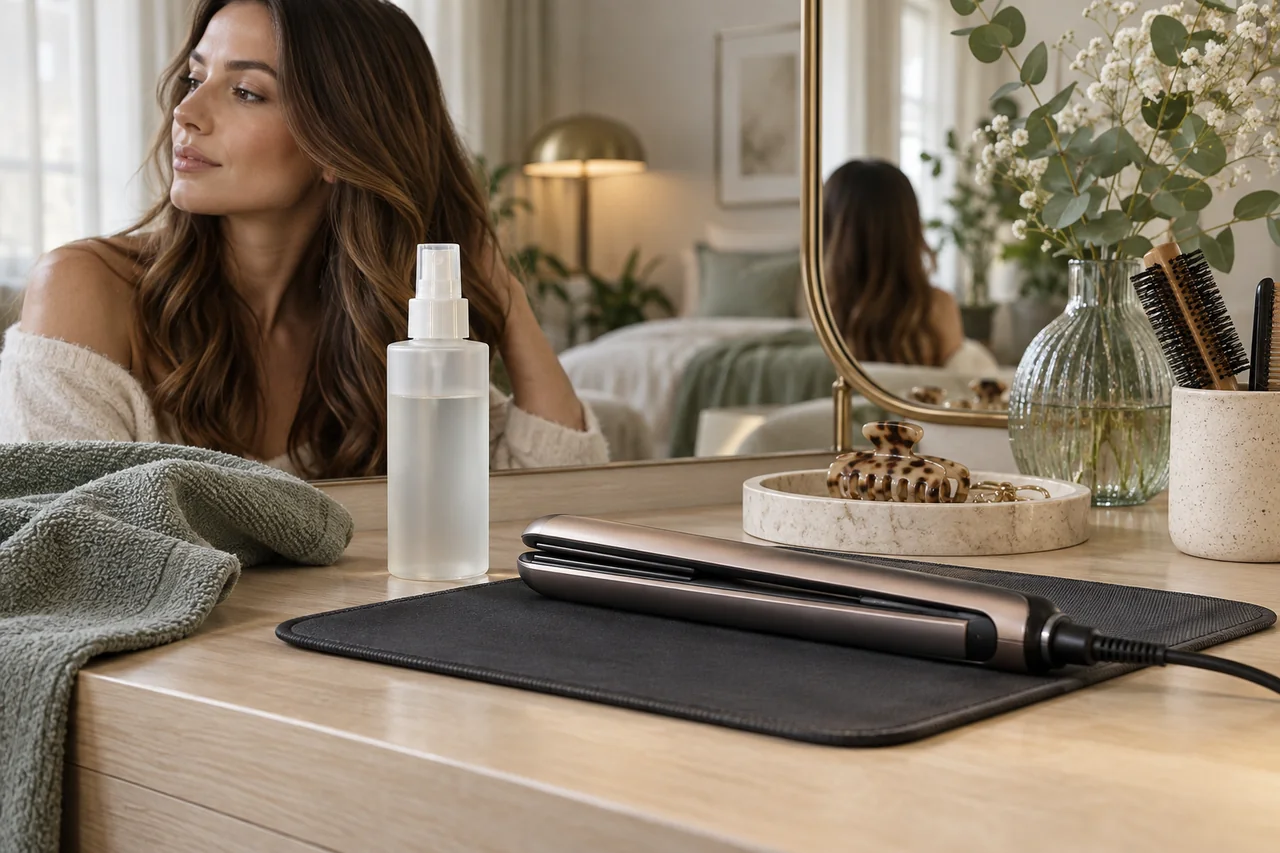
A heat-protection product does not remove the need to control heat. Its stated purpose and directions must fit the appliance and styling step you intend to use.
Read the complete directions
Check official instructions for damp or dry application, the intended appliance, amount, distribution and any waiting time. A large temperature claim on the front does not replace those details. If instructions are missing or contradictory, ask the manufacturer rather than improvising. You can keep a photograph for your own reference. Words such as care, shine or oil do not establish heat protection for your intended use.
Do not assume extra functions
Some leave-in products are labelled as providing heat protection; the American Academy of Dermatology advises checking for that claim. It does not apply to every conditioner or oil. Check whether a suitable product is already in your routine before adding another layer. If combining products, make sure their intended uses fit together. A simpler routine is easier to control than a homemade mixture; manufacturer guidance concerns the finished product as supplied.
Plan even application
Section the hair so you can reach the intended areas, following the stated amount and spray distance or hand application method. One quick surface spray does not automatically reach the sections underneath, while more product does not automatically mean more protection. Use a clear sequence of sectioning, applying and any required preparation. Keep mist away from your face and eyes and follow all packaging warnings.
Continue to control the appliance
The AAD recommends dry hair and low to medium settings for straighteners and warns against excessive heat generally. Follow your particular appliance instructions as well. If you have applied a product, the hair must still reach the condition required by the device; do not proceed with a damp section when dry hair is required. If the desired shape needs many passes, review the technique or choose another style instead of repeatedly increasing heat.
Turn claims into useful questions
For a claimed protection temperature, ask which application and testing conditions support it. You do not have to reproduce a laboratory test, but the number is not your personal safe appliance setting. “Professional” or “salon-like” does not establish easy use either. Compare application, tolerance, styling result and cost. Without comparable test data, a personal styling trial cannot objectively rank protection performance.
Simplify your heat routine
List the heat steps you actually use. Blow-drying may already provide the result you want, with straightening added only by habit. Remove an unnecessary step before adding products. Record a controlled starting setting consistent with your appliance instructions. Seek professional advice for persistent noticeable breakage or symptoms; organising styling is not an individual examination.
For example, compare the official directions for your leave-in and separate protection spray. If the leave-in explicitly covers your intended use, a second layer is not automatically needed. If its function is unclear, ask. This stock check may avoid duplication, but cannot tell you which product protects better in laboratory testing.
Frequently asked questions
Can I use hair oil instead of heat protection?
Only if that particular product is explicitly intended for the relevant heat application. The word oil does not prove the function. Do not improvise with cooking oils.
Does heat protection prevent all damage?
No complete guarantee follows from using it. The appliance, temperature, number of passes and correct application still matter. Continue to limit unnecessary heat.
Questions and experiences
Share a question or a useful experience about this topic. Every contribution is checked before publication. Comments may be written in different languages.
Loading reader contributions…
Opening the form sets a necessary session cookie. No email address is required. Publication is subject to moderation and is not guaranteed. For deletion requests: Contact