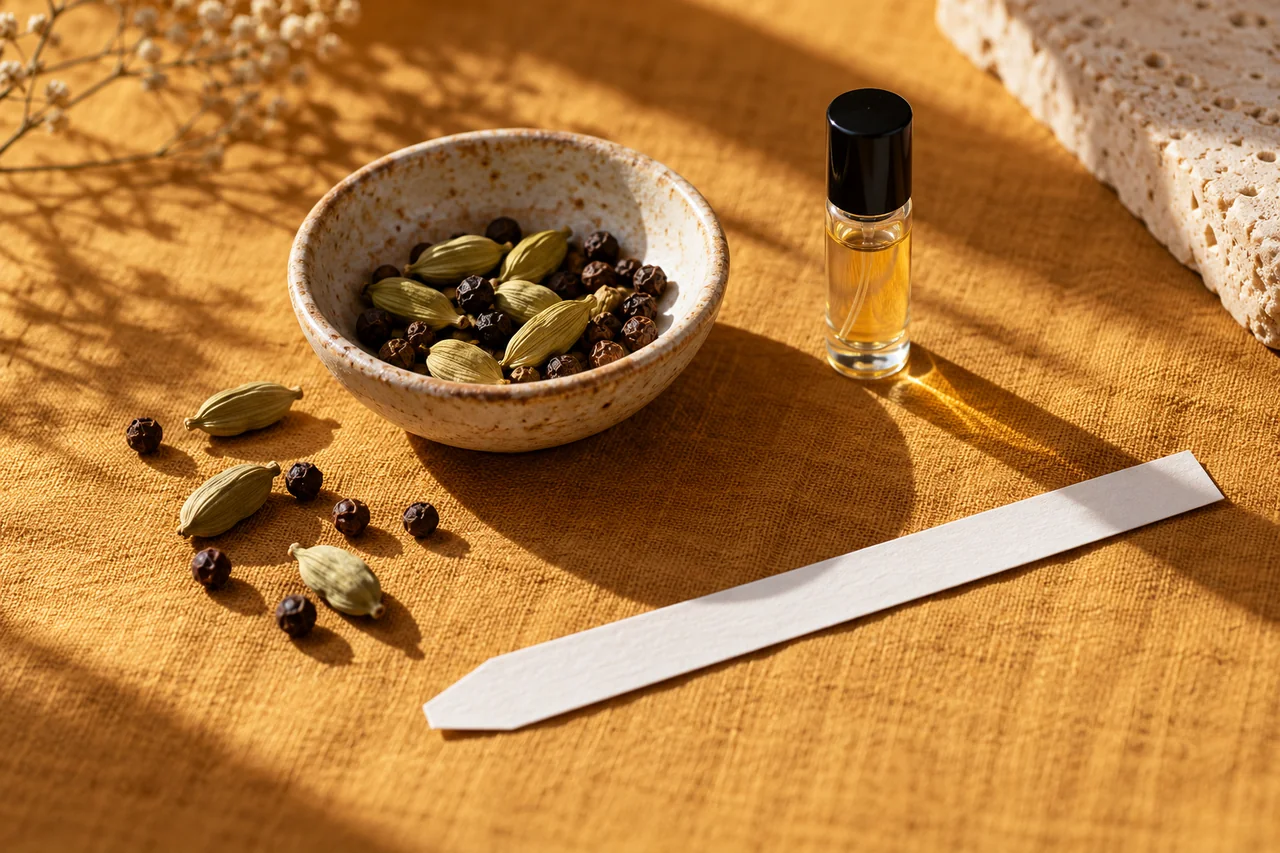
Spicy may describe bright dry tension or a warm, sweeter impression, not only winter baking. Decide whether spice should enliven the fragrance, warm it or become the main theme. Different roles lead to different useful samples.
Describe a contrast
Imagine dry pepper versus a warm spice kitchen, then specify sweetness: bright without baking associations, or warm and soft without sharp edges. Memories provide language. Do not deeply inhale spices, apply them to skin or mix them with perfume. Assess a labelled finished product as a whole.
Identify the role of spice
Some scents add spice to flowers or wood; others feel dominated by it. Record accent or main theme beside the name. If you want quiet wood, a little spice may help while an all-encompassing spicy effect misses the brief. Identifying every advertised spice is unnecessary.
Compare light and warm versions
Try one brighter, drier sample and one warmer, softer version separately, with pauses. Give each three words and a possible occasion. A warm version may fascinate briefly while a lighter one seems more wearable. This is about distinct uses, not forcing one universal winner.
Respect discomfort and development
You need not learn to tolerate a sharp, piercing or overly prominent impression because a scent is called sophisticated. Stop the comparison and record the issue. If it causes symptoms, discontinue use; style advice cannot diagnose the cause or recommend continuing. For a suitable favourite, observe whether the later scent grows sweeter or whether spice becomes too dominant or pleasantly balanced.
Choose a genuine addition
Does it bring a wanted new contrast or merely another warm option? A rare spicy mood may need only a small size. Compare total spend with realistic occasions and respect shared rooms, where intriguing spice can be too present. A precise next brief might be a bright accent that does not become sweeter later.
Frequently asked questions
Are spicy scents only for cold days?
No. Bright and warm interpretations differ. Actual presence, preference and the situation guide the choice.
Does a spice note mean the kitchen ingredient is included?
No. A note describes a smell impression. Product information addresses composition; the description is not a mixing recipe.
Questions and experiences
Share a question or a useful experience about this topic. Every contribution is checked before publication. Comments may be written in different languages.
Loading reader contributions…
Opening the form sets a necessary session cookie. No email address is required. Publication is subject to moderation and is not guaranteed. For deletion requests: Contact