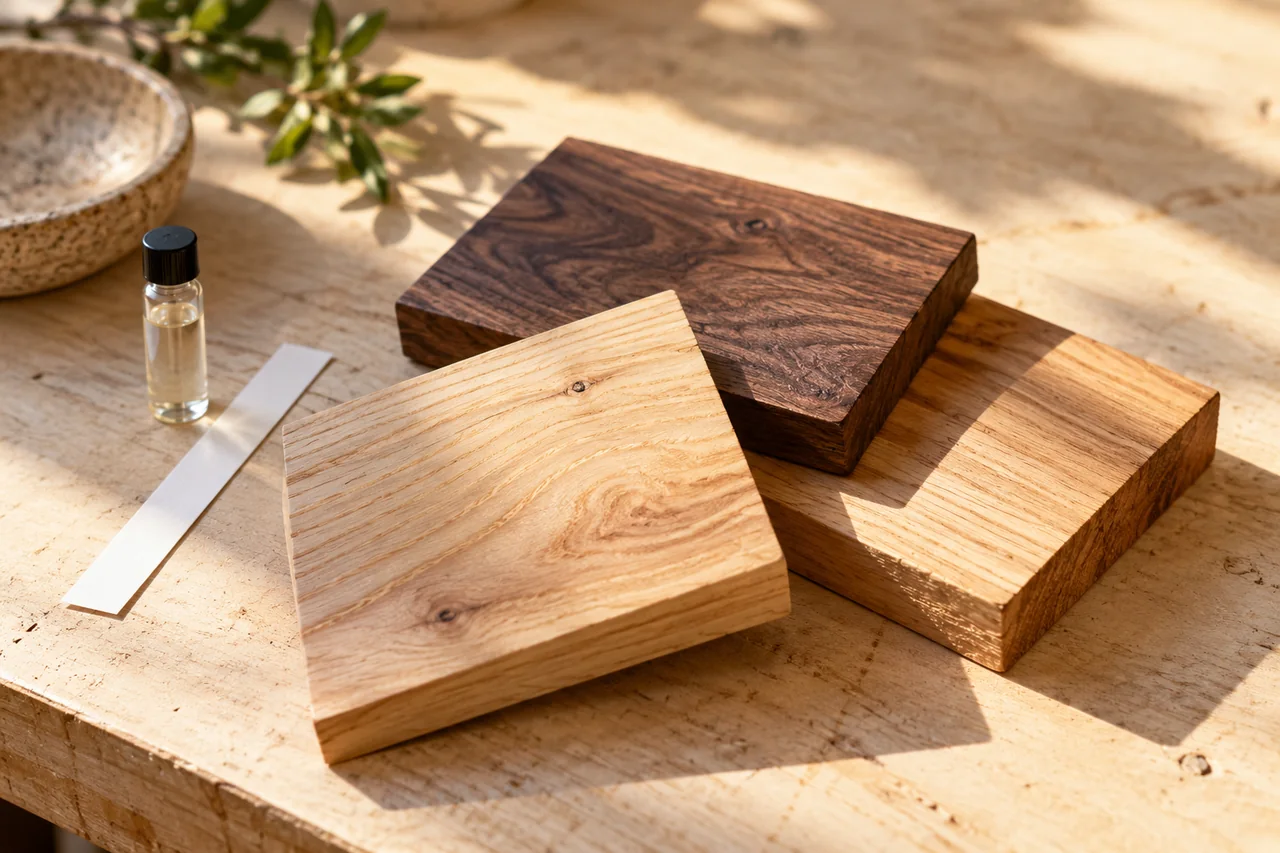
Woody is a broad idea: dry shavings, polished smoothness, dark furniture or smoke. These distinctions are more useful than assumptions about masculinity or maturity. Begin with the wood association you enjoy, then assess its surroundings in the whole perfume.
Build a material map
Imagine a sharpened pencil, polished wooden bowl and dark old cupboard without deliberately sniffing objects. Which memory is closest to your wish? Add whether you want a dry edge or greater softness. The perfume need not reproduce the object literally; the image makes your expectation clearer.
Separate smoke and sweetness
You may enjoy crisp dry wood but dislike smoke, or want a dark smoky accent. Record these independently. Similarly, a rounded, soft wood need not suggest dessert. Ask both how angular or soft the sample feels and how sweet it seems. Write your own words before reading the full story.
Compare texture and development
Draw angular-to-soft and light-to-dark axes. Place an early and later impression for each sample without pretending to produce scientific data. A bright opening that becomes soft may appeal, while growing darkness may not. Turn that into a request such as light wood with a soft development and little smoke.
Read raw-material claims carefully
Cedar, sandalwood or oud may appear as a material claim, note or creative description. Establish what the maker actually says before inferring source or quantity. Wood imagery proves neither. Ethical and ecological priorities require specific, traceable product and supply-chain information. Raw-material price cannot rank your personal enjoyment.
Choose a useful role
Test restrained presence in the intended setting without gender labels. If you already own warm perfumes, a lighter dry option may add more than another dense one. If you mainly enjoy freshness, fresh-woody may be an easier bridge. Buy for a real addition and keep both preferences and exclusions, such as liking wood without strong smoke.
Frequently asked questions
Are woody scents fundamentally for men?
No. Anyone may enjoy them. Retail categories are navigation aids, not boundaries for taste.
Does an expensive wood story prove a better fragrance?
No. It may add background, but cannot replace verifiable product claims or your assessment of enjoyment, development and practical use.
Questions and experiences
Share a question or a useful experience about this topic. Every contribution is checked before publication. Comments may be written in different languages.
Loading reader contributions…
Opening the form sets a necessary session cookie. No email address is required. Publication is subject to moderation and is not guaranteed. For deletion requests: Contact