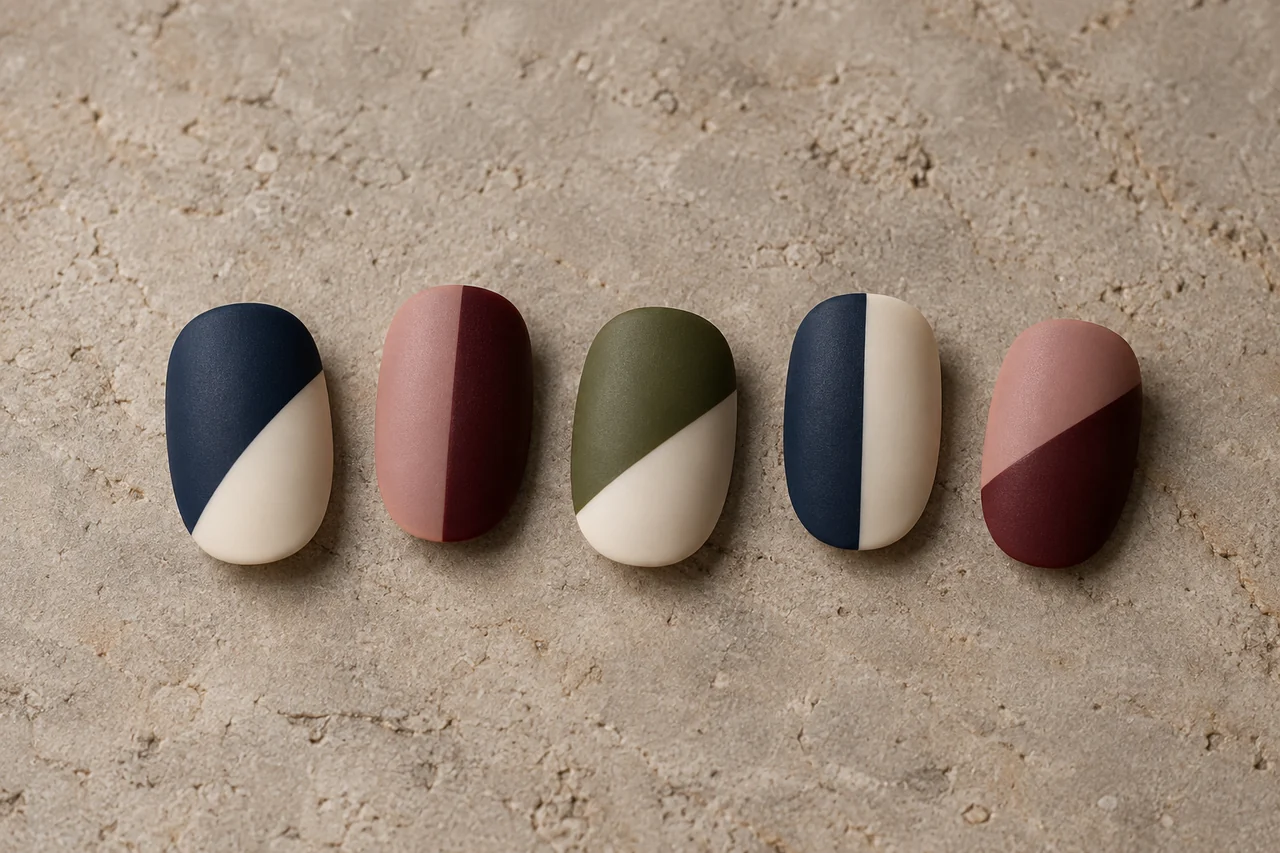
Two clearly separated colour areas can create a complete nail design. Their relative size and boundary matter more than the number of colours or techniques used.
Choose the pair without extra decoration
Begin with two existing colours you like together, such as navy and cream or rose and burgundy. Real samples are more informative than bottles or screens. Decide whether you want strong contrast or closely related tones. Leave glitter, symbols and extra lines out of the first comparison so they do not obscure the basic pair.
Draw three divisions
Use equal outlines with a lengthwise split, diagonal division and crosswise area near the tip, keeping the colours the same. This reveals geometry independently. A diagonal suggests a different direction from a vertical line, but neither guarantees an optical change to your fingers. Choose what you like on your actual nail shape rather than following a compulsory elongating rule.
Move the balance of the areas
Copy the preferred outline with roughly equal areas, then with only a small corner in the stronger colour. Decide whether that colour leads or accents. Exact percentages are unnecessary. “Mostly cream with a small blue corner” prevents the intended balance being reversed at a salon. Colour names alone do not describe the design completely.
Keep the boundary understandable
The execution method depends on appropriate products and technique, but first decide where the line belongs on paper. If a narrow shape is difficult to repeat, simplify. A larger clear corner may work better than many small subdivisions needing corrections. Compare equal blocks, a small contrasting corner and a narrow crosswise area, asking whether the main colour retains enough space.
Plan the whole hand and a manageable trial
Repeat the same division or mirror selected areas. A shared rule, such as a small dark corner, can connect an asymmetric sequence. A fully dark nail changes the visual weight, so add it to the sketch before deciding.
For ordinary-polish practice, use suitable compatible products according to their directions and begin on a sample. Geometry is not a reason to mix technical systems casually. One accent corner with the remaining nails plain can test the effect without repeating ten complex boundaries. Allow the intended application and drying time.
Keep the useful version
Compare beside light and dark clothing. Note whether the next change should concern shade, boundary or area balance. If geometry works but contrast is too strong, try related colours. If the colours work but the layout feels unsettled, simplify the division while keeping them. This produces a reusable personal reference rather than a one-off guess.
Frequently asked questions
Do colour-block nails need bright colours?
No. Related shades can still form distinct areas. Decide whether you want a strong colour contrast or mainly a quiet geometric division.
Can I use three colours?
Yes, but the third creates another area needing a planned size and position. Establish a clear two-colour design before adding it.
Must both hands have identical divisions?
No. Mirroring or another deliberate arrangement is possible. Repeat the same pair and a similar area balance to connect them.
Questions and experiences
Share a question or a useful experience about this topic. Every contribution is checked before publication. Comments may be written in different languages.
Loading reader contributions…
Opening the form sets a necessary session cookie. No email address is required. Publication is subject to moderation and is not guaranteed. For deletion requests: Contact