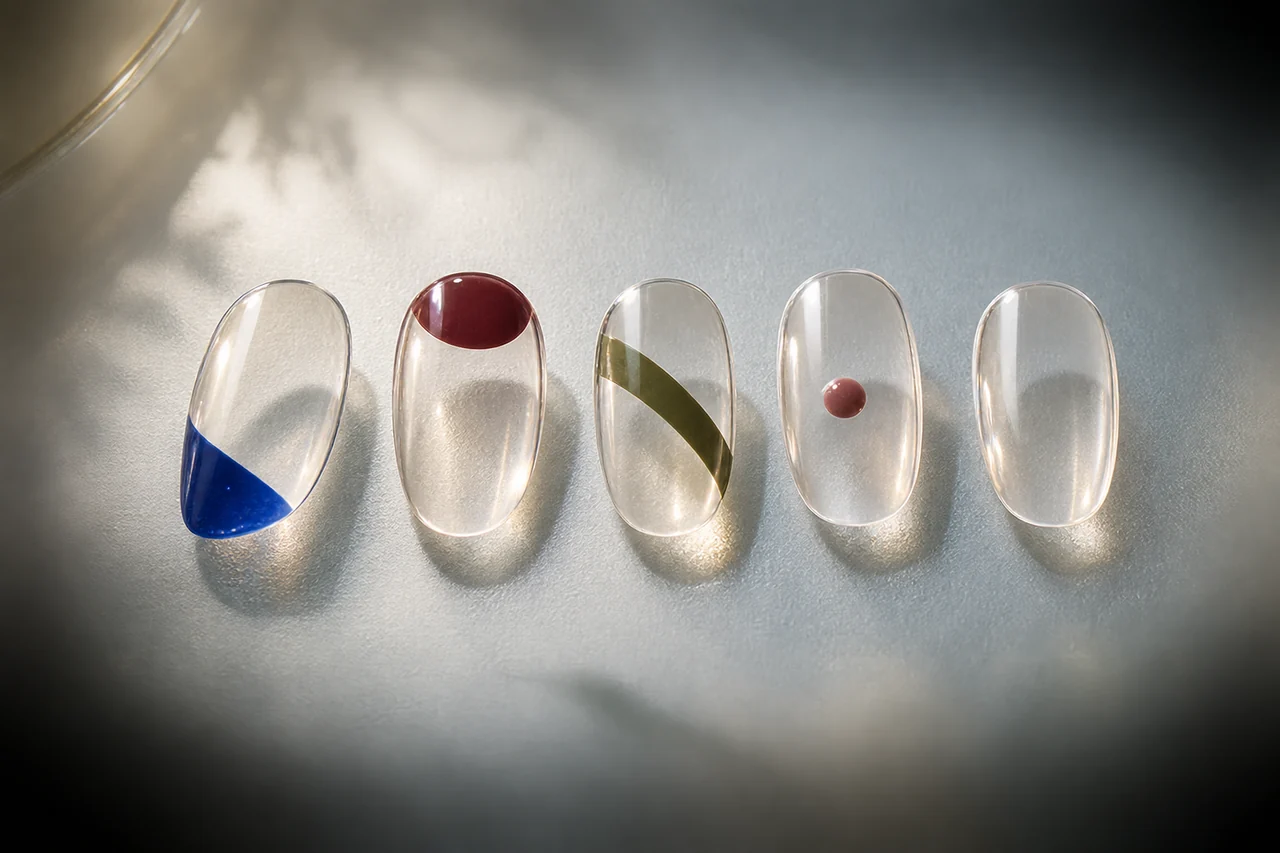
In negative-space styling, the open area belongs to the design. It need not be filled later. Clarify whether “open” means unpainted, clear-coated or a sheer coloured base, because those effects differ.
Clarify the visible background
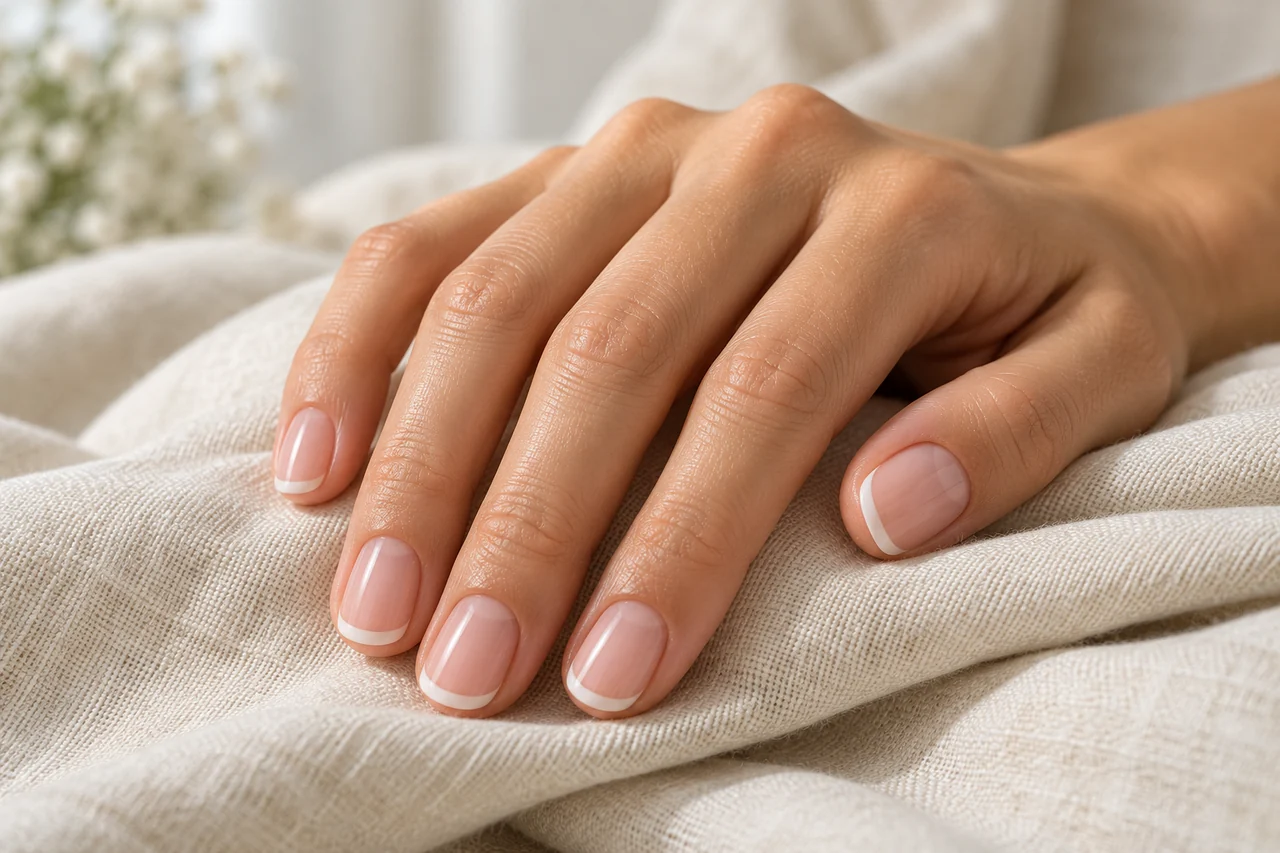
A sheer rosy base changes colour differently from clear or unpainted nail. Tell a salon how much natural colour may show. Nude is not precise enough: an opaque skin-adjacent shade remains a filled surface even when quiet. Distinguish actual transparency from a restrained colour so the system is not chosen from an ambiguous word.
Draw the open space first
Sketch three outlines with a narrow side stripe, small corner and single arc. Leave the remaining space intentionally open. Does that space have a clear shape or simply seem left over? A smaller corner or a line moved away from the edge may help. Mathematical symmetry is unnecessary; the motif and background should appear planned together.
Compare size and contrast separately
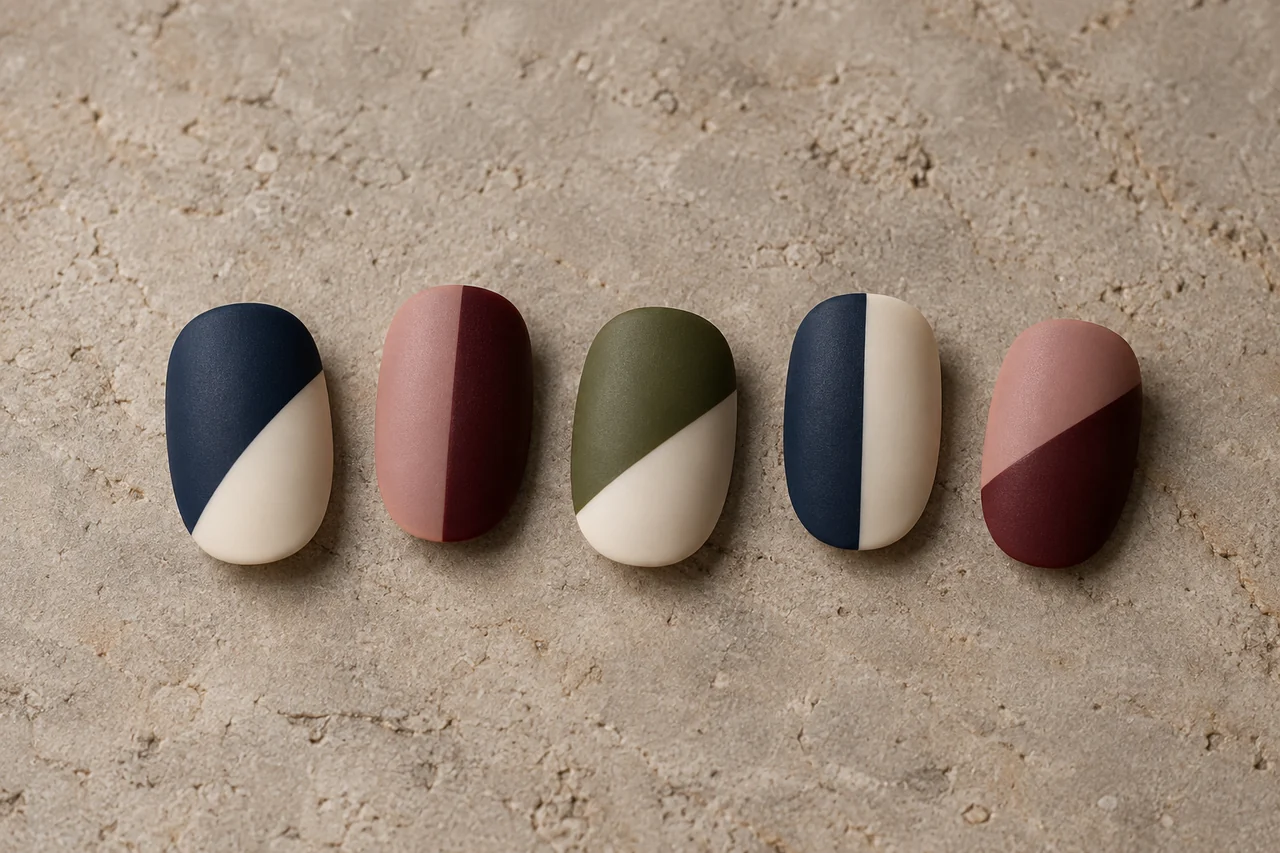
A small navy triangle can stand out on sheer nail, while a similarly sized pale rose shape may be subtle. To make an idea stronger, test contrast before enlarging every motif. To keep a large shape but reduce dominance, try a quieter colour. Note which size stays constant so you can distinguish shape changes from colour changes.
Use one family of forms
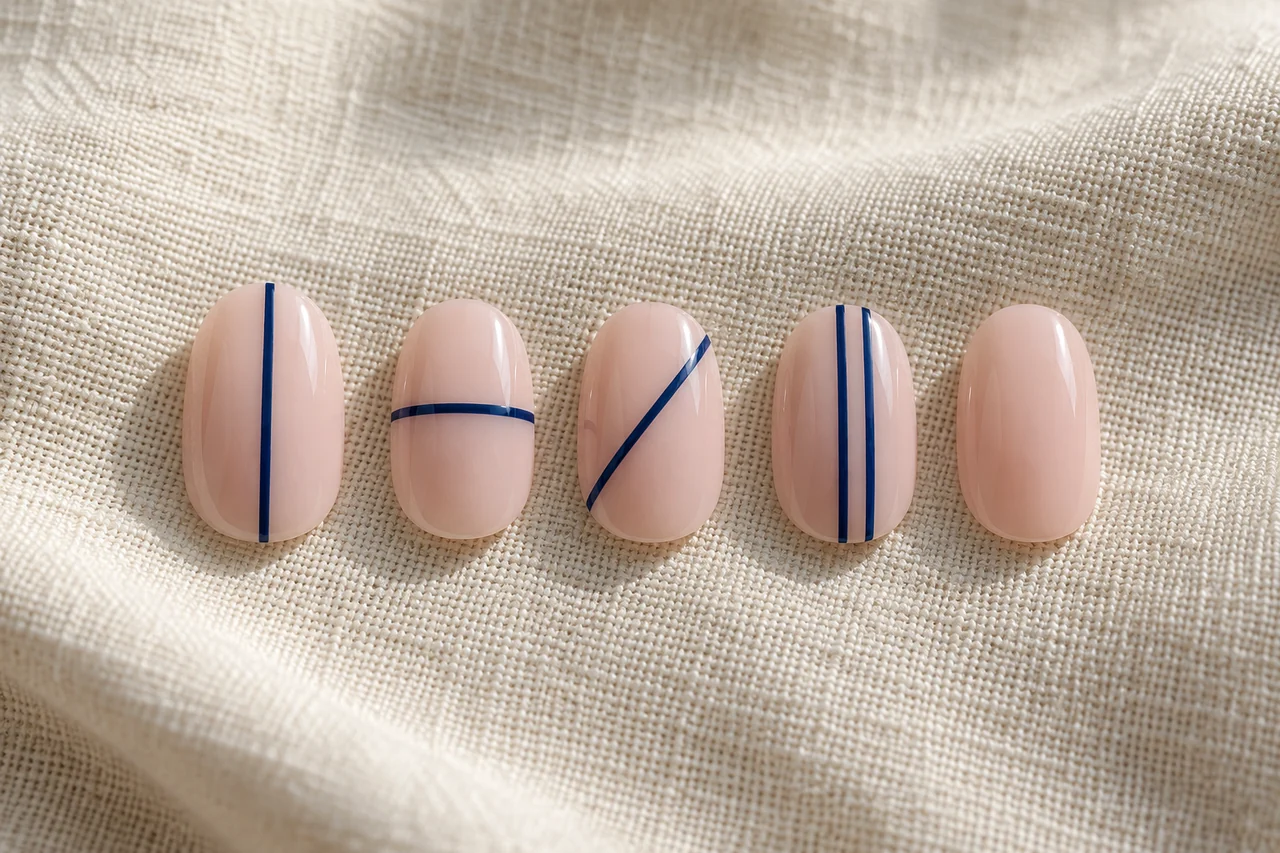
Corners, arcs or lines can vary in position while remaining connected. For a first design, avoid adding flowers, dots, lace and metallic accents simultaneously. One small corner preserves a large sheer area; a side stripe gives direction; an open arc uses line instead of a block. These are starting options, not fixed rules.
Adapt to each nail and an appropriate process
A stripe occupies more of a narrow nail than a thumb, so adjust its visual width. A tip motif may resemble French styling, while the same shape near the base directs attention differently. Short nails often benefit from fewer subdivisions.
For home practice, use suitable ordinary polish as directed on a sample first. Household glue and improvised aids are unnecessary. At a salon, ask how the transparent effect is achieved and removed, and distinguish actual open space from a pale opaque base.
Judge three views
Look close up for the line, at arm’s length for colour-to-space balance and beside an ordinary outfit for overall contrast. Record one observation per view. If a detail is attractive close up but almost invisible farther away, decide whether that is your intention. Every design need not attract maximum attention from several metres away.
Frequently asked questions
Must part of the nail be completely unpainted?
Not necessarily. The term is also used for sheer-base designs. Clarify the surface and visible natural colour you want before application.
Is negative space automatically subtle?
No. A small high-contrast area can stand out strongly. Colour, filled area and motif all influence the effect; compare them separately.
Can I combine several patterns?
Yes. One shared family of forms makes a first design easier to assess. Add other motifs once you know which open areas you want to preserve.
Questions and experiences
Share a question or a useful experience about this topic. Every contribution is checked before publication. Comments may be written in different languages.
Loading reader contributions…
Opening the form sets a necessary session cookie. No email address is required. Publication is subject to moderation and is not guaranteed. For deletion requests: Contact