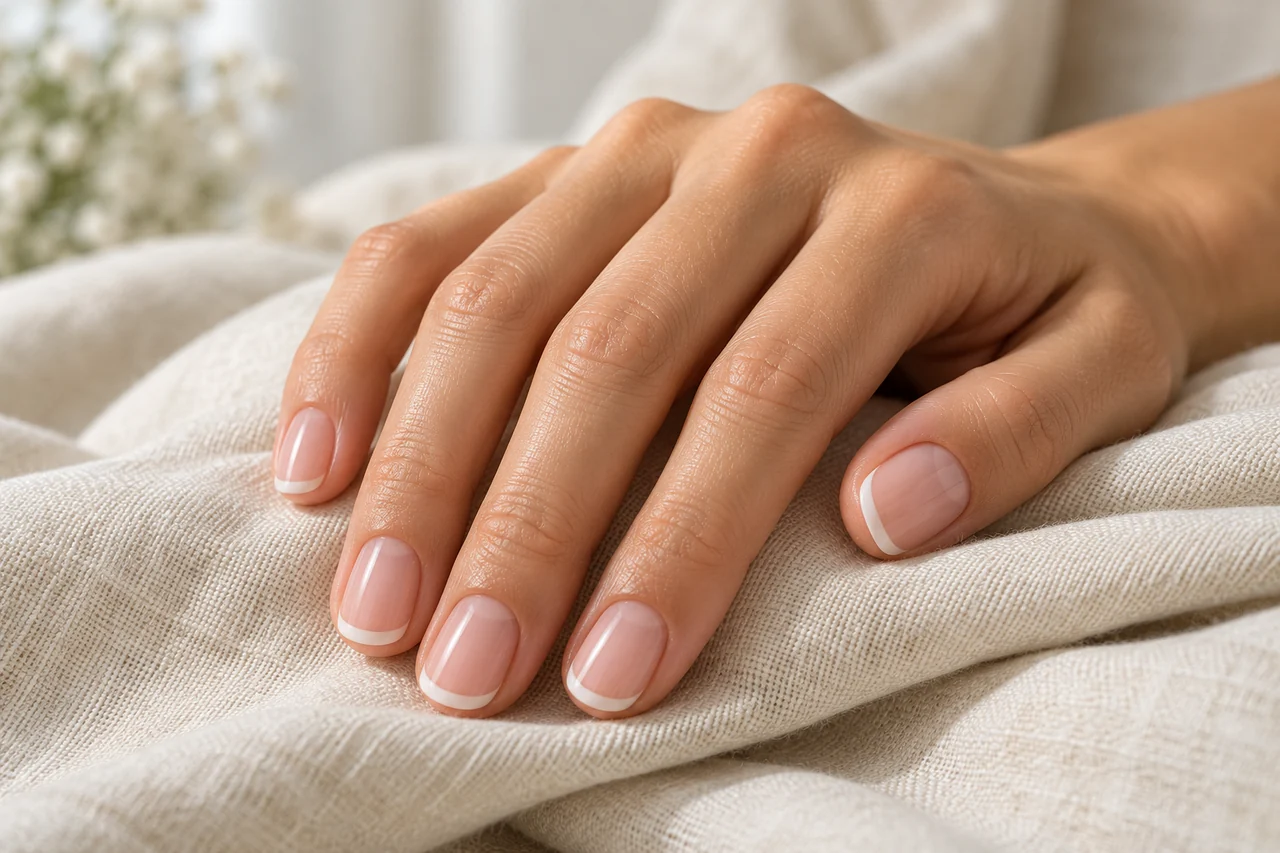
French styling does not require a long white free edge. A fine line can emphasise a short nail’s outline, while a wider pale band looks more graphic. Micro French describes a particularly fine tip, not a fixed millimetre measurement.
Start with your existing surface
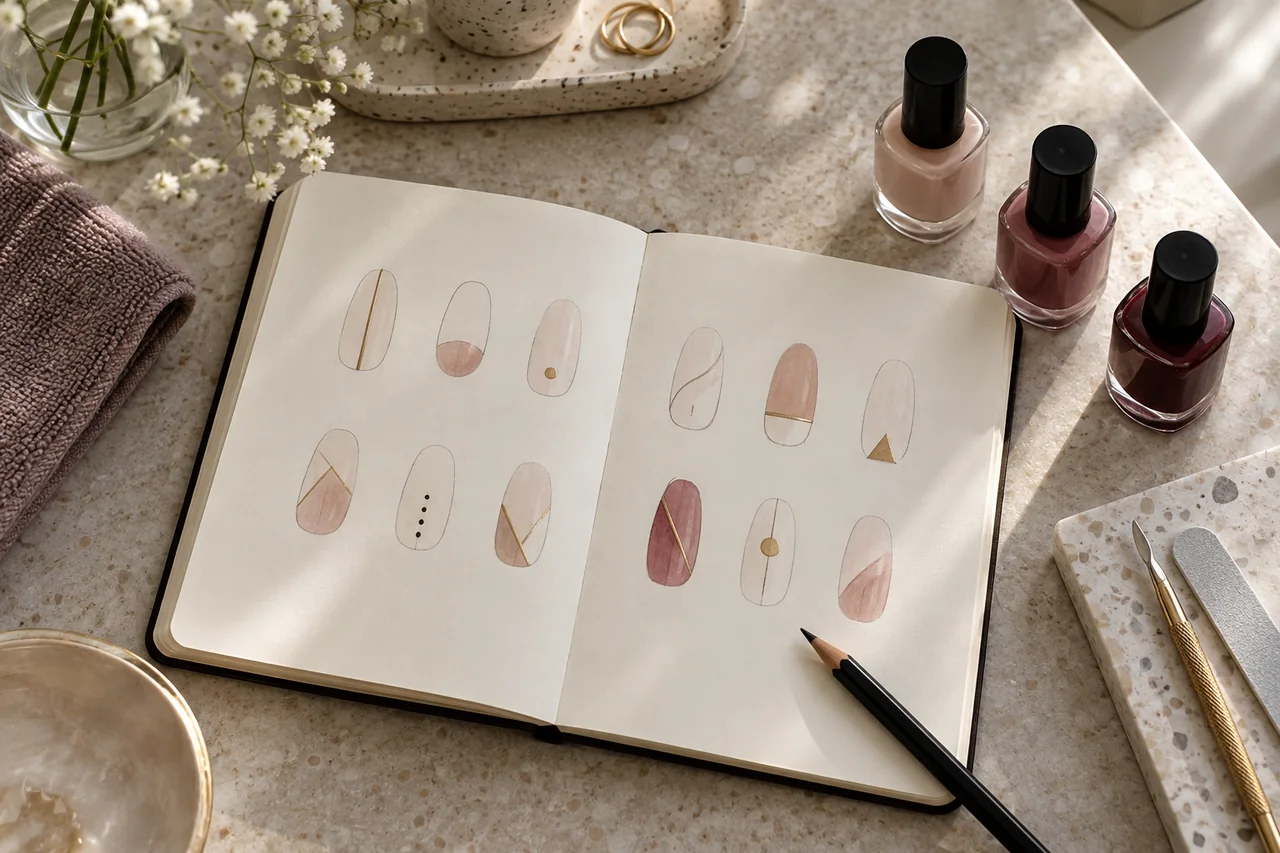
Look at relaxed fingers from above and notice the thumb, little finger and actual free edges. Draw five approximate outlines on paper. This gives you a realistic design space instead of copying proportions from a long almond reference. Keep your current length as a fixed part of the brief; the design need not force an extension.
Compare three tip widths
Copy an outline three times, adding a very fine line, a narrow band and a broad tip over the same base. View them from the same distance. Which remains visible without letting the white area dominate? A little finger may need less visual weight than a thumb. Identical physical widths on different surfaces can look unequally prominent.
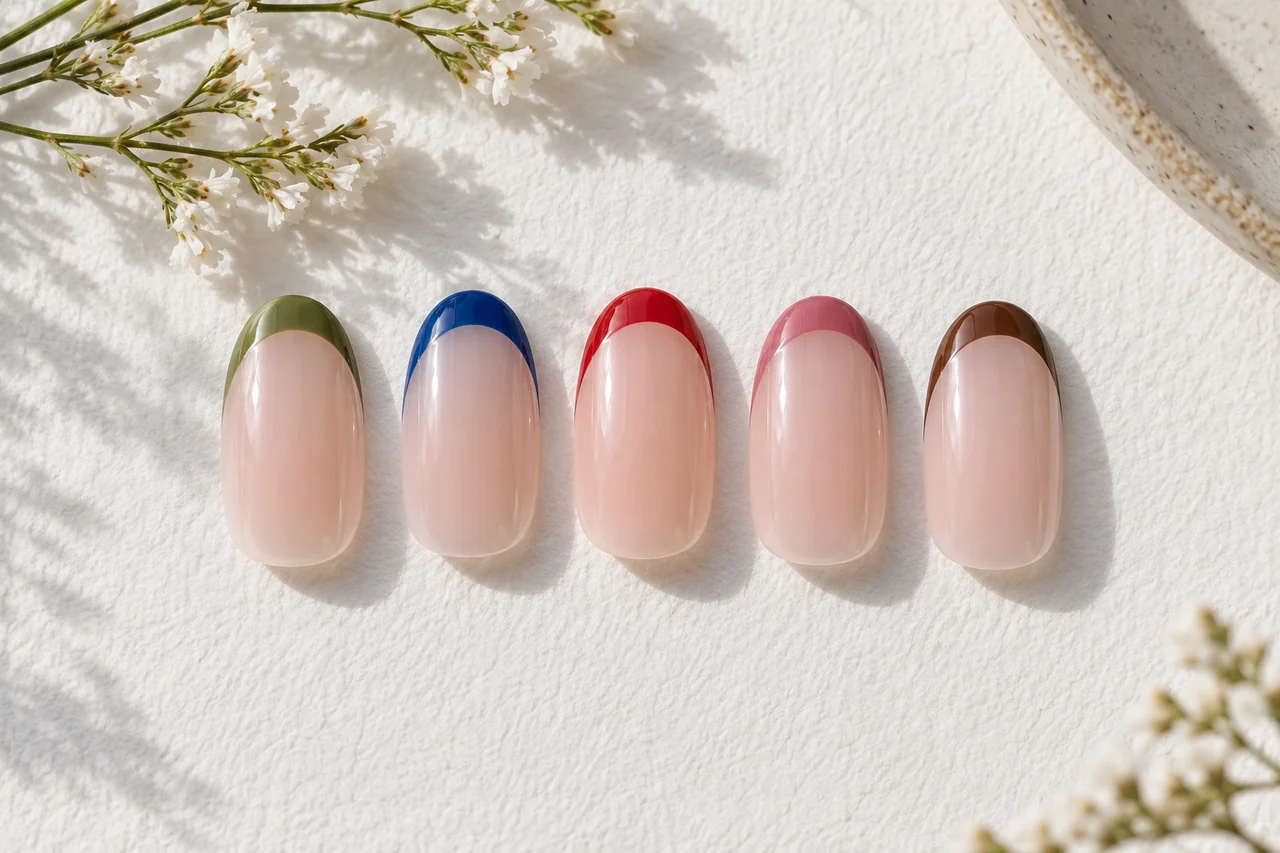
Choose the white deliberately
Pure white gives stronger contrast than off-white or milky cream. Neither is inherently better. Compare both against the same rosy or sheer base and with jewellery you normally wear. You do not need matching new accessories. The familiar outfit is simply a reference for deciding whether you prefer a clearer or softer edge.
Give the base a clear role
A sheer base leaves more natural colour and edge visible; a more opaque rose creates a more even coloured background. Decide whether you want a translucent or more drawn effect. A visible natural edge is not a mistake in a sheer concept. “Natural” alone is too vague, since it can mean almost invisible colour to one person and full beige coverage to another.
Try a manageable polish version
For home practice, use suitable air-drying nail products and tools as instructed, starting on an intended sample surface. A colour polish and appropriate fine tool may suffice. A gel-look name does not establish application. Aim for one calm line in one colour rather than repeatedly adding correction layers. If the attempt becomes complicated, restarting a sample may be clearer.
Review the whole hand and write the brief
Check the idea in daylight, at a desk and from a little distance. Tiny close-up irregularities may disappear in ordinary viewing, while a broad bright edge may dominate more than expected. Record width, contrast and base, then change just one next time.
A salon brief might be: “Keep my short gently rounded shape, use a sheer rosy base and a very narrow off-white tip; the natural edge may show. Please discuss the proportion on one nail first.” Ask separately about the process, total price and removal. The visual request does not decide the technical system.
Frequently asked questions
Do French nails need a long free edge?
No. A fine visual edge can be planned on short nails. The relationship to the available surface matters; extensions are not required by the design.
Must every tip be exactly the same width?
Not necessarily. Thumb and little finger have different surface areas. Aim for a similar visual proportion and connected line style, checking the whole hand from a little distance.
Is micro French a separate polish system?
No. Here it describes a very fine tip. Ask separately which product, application and removal process will be used.

Questions and experiences
Share a question or a useful experience about this topic. Every contribution is checked before publication. Comments may be written in different languages.
Loading reader contributions…
Opening the form sets a necessary session cookie. No email address is required. Publication is subject to moderation and is not guaranteed. For deletion requests: Contact