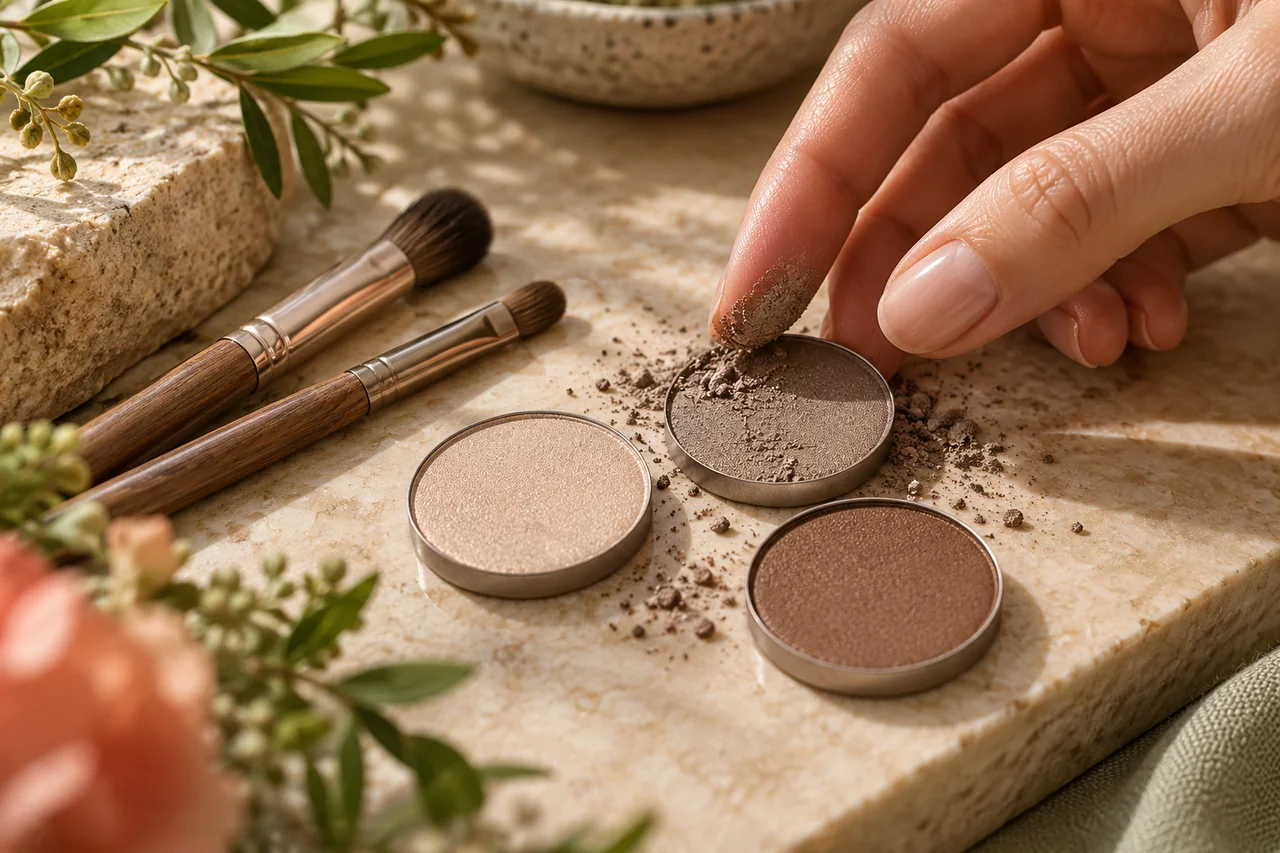
You can learn a coherent eyeshadow look with two colours and a clean blending brush. The useful questions are what remains visible with your eyes open and how easily you can control the amount.
Choose two colours
Pick a main shade and a somewhat darker accent: beige and brown are only one option; rose and plum or muted greens can work too. Start with a recognisable but moderate depth difference. Put other shades aside. Use only cosmetics intended for the eye area; similar colour does not make another product suitable.
Build a thin main area
With a small suitable brush, start in the centre of the intended lid area and move the remaining product towards its edges. You need not cover everything up to the brow. Check evenness, adding locally where needed instead of repeatedly rubbing the whole surface.
Place the darker accent
Use little product on the outer area or another location you deliberately want to emphasise. It need not trace a prescribed crease. Open the eyes and relax the brows: an accent visible only with raised eyebrows may not meet your everyday aim. Adjust the small visible area rather than extending colour everywhere.
Blend with a clean tool
A brush without fresh pigment can soften the border. Use a few light movements on the transition, leaving the darker centre where you intended. Overblending the whole lid merges the shades into one broad patch. Reduce accidental excess before covering it with another light layer.
Keep a repeatable recipe
Try taupe with a small outer brown accent, then balance only the area that differs between sides. Add mascara if wanted and leave extra palette colours alone. Record shades, tools and sequence; an unfiltered private photograph can help if you remember its dependence on light. Change one element next time. A single-colour look remains equally complete.
Frequently asked questions
Is a pale brow-bone shade essential?
No. It can be an intentional accent, but first see how the natural skin there supports the look.
Why does the dark colour disappear during blending?
You may be blending the entire area instead of its edge. Use lighter pressure and a clean brush, then add colour locally only if still needed.
Questions and experiences
Share a question or a useful experience about this topic. Every contribution is checked before publication. Comments may be written in different languages.
Loading reader contributions…
Opening the form sets a necessary session cookie. No email address is required. Publication is subject to moderation and is not guaranteed. For deletion requests: Contact