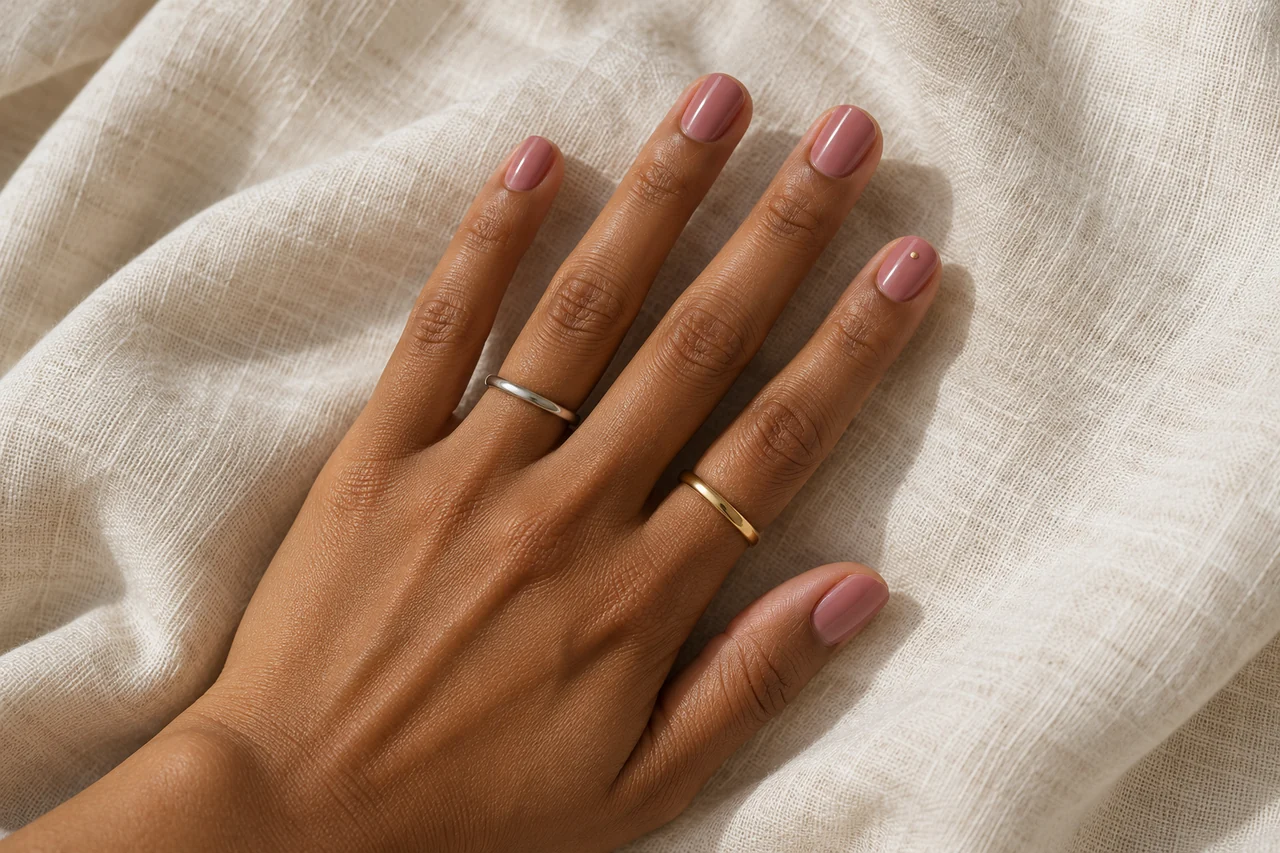
A ring and nail accent often sit close together, but need not share a metal colour or style. Decide what should lead and what should accompany it using jewellery you already wear.
Start with familiar jewellery
Put on your usual rings or bracelets rather than selecting arbitrary accessories for an ideal photograph. Notice broad surfaces, fine lines, round stones and small details. Choose one feature to echo and one that need not be repeated. A broad plain ring already provides a metallic block; the manicure can be colourful, quiet or contrasting without replacing the jewellery to match a new polish name.
Choose the emphasis
Hold a plain colour sample beside the ring, then a patterned one. Notice where attention goes. A calmer nail may support a featured ring, while a strong colour can make the manicure lead. Both can be prominent deliberately. An attractive detail chosen alone may compete unexpectedly when several others are already strong.
Treat metals as choices rather than rules
Gold, silver and mixed metals can accompany many polish shades. Warm and cool impressions can guide a comparison without assigning fixed rules to skin colour or personality. Try the actual combination in similar light. You may enjoy warm brown against cool metal or prefer a softer repetition. Record the visible effect rather than a categorical colour-type judgement.
Compare three versions
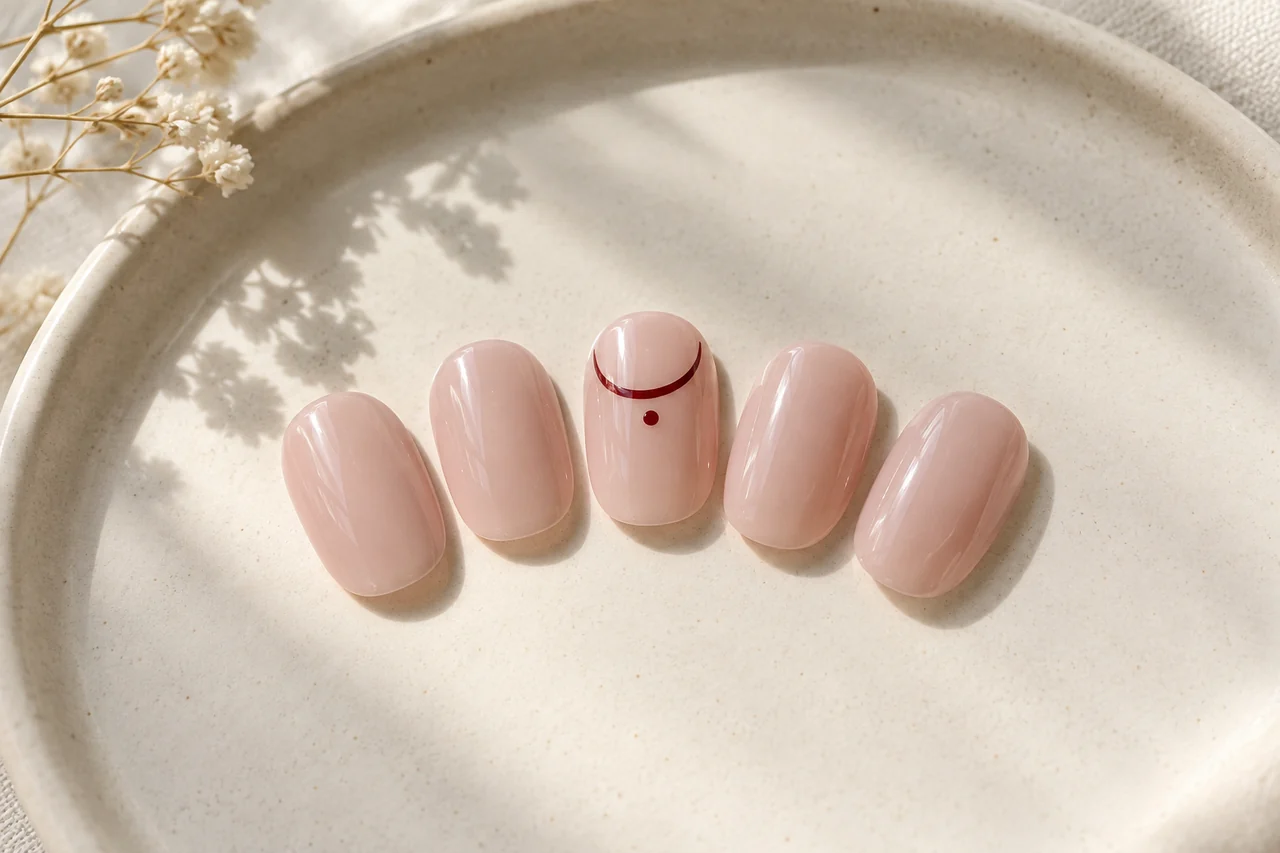
With the same jewellery, try a plain colour, the same colour with a small metallic-looking painted detail and a stronger pattern. Ask whether the extra accent adds a useful connection or duplicates shine the ring already supplies. A sample card can explore the direction without buying matching particles. Compare jewellery as the focal point, a small repeating accent and a deliberate contrast.
Choose position and practical form
An accent beside a prominent ring concentrates attention; one on the other hand distributes it. Sketch both. The ring finger is not compulsory; you may prefer seeing a thumb or index detail. Consider the number of rings actually worn.
A flat suitable polish effect or painted mark can suggest metal without raised pieces. Follow cosmetic product and decoration instructions. Check comfort with your jewellery and length, and honour actual workplace nail and jewellery requirements rather than improvising exceptions.
Record one repeatable combination
Note the ring group, base and accent position: “Fine silver ring, muted rose, one small pale dot on the thumb”, for example. Photograph in ordinary light if useful. Next time change only the base shade or accent position so you can see what improves the focus, rather than changing polish, jewellery and sleeve together.
Frequently asked questions
Must polish match gold or silver?
There is no fixed assignment. Compare the shade with jewellery you really wear. Repetition and deliberate contrast can both work.
Should the accent be on the ring finger?
Not necessarily. An accent beside a ring concentrates attention, while another position spreads it. Choose the overall effect you want.
Do I need jewellery pieces on the nails?
No. A flat painted detail or suitable polish effect can connect the ideas. Raised decorations are not required.
Questions and experiences
Share a question or a useful experience about this topic. Every contribution is checked before publication. Comments may be written in different languages.
Loading reader contributions…
Opening the form sets a necessary session cookie. No email address is required. Publication is subject to moderation and is not guaranteed. For deletion requests: Contact