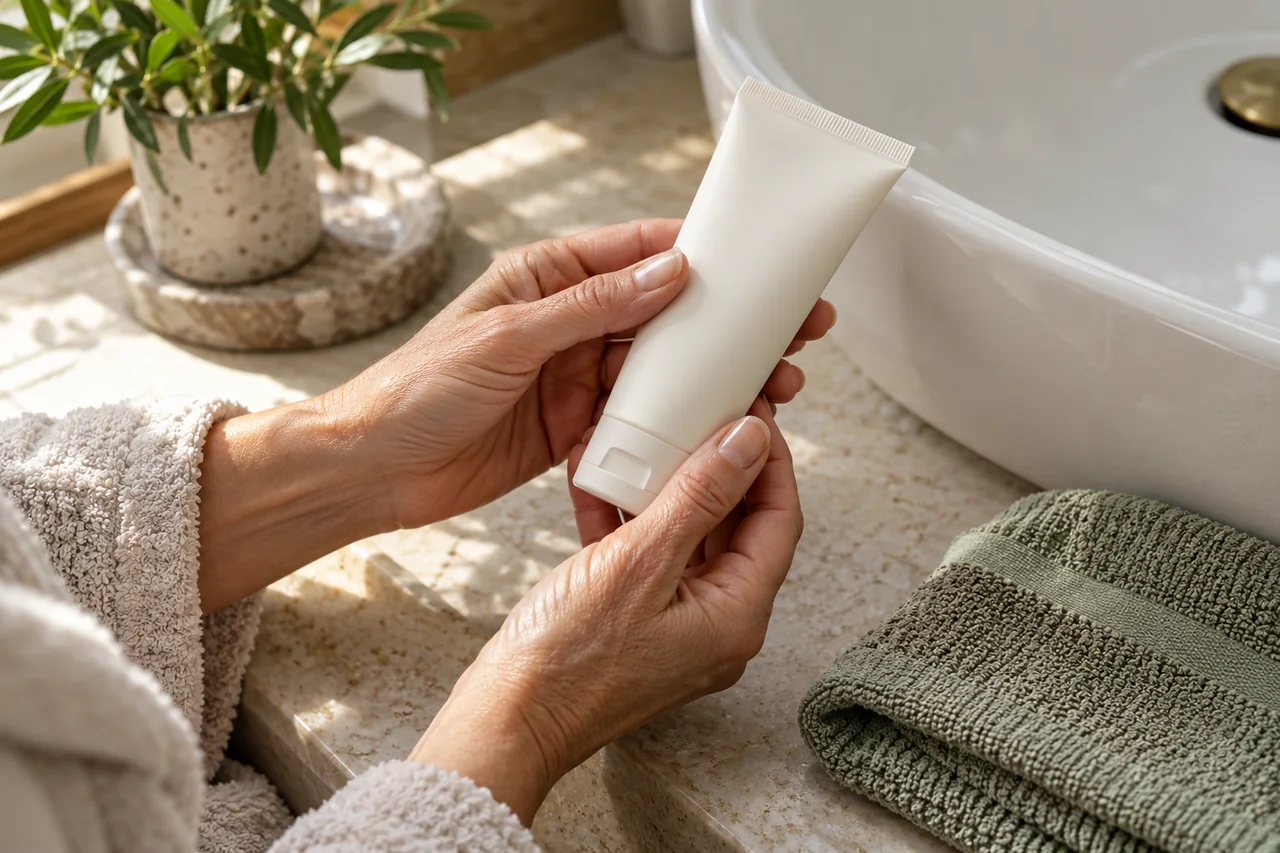
A useful routine starts with when and where you can actually use it. You do not need a large shelf of products to care for your hands deliberately.
Observe the daily pattern
Notice washing, water-related tasks and travel. Choose one point where an existing suitable product can be within reach. A tube hidden in a drawer is less useful if forgotten. You may need only one regular location and, if genuinely useful, a clearly labelled travel pack. Keep directions with the product rather than building the routine around an attractive collection.
Describe a practical need
Aim for a more comfortable feeling after washing, remembering evening care or organising the space. “Perfect hands” is difficult to assess. Persistent itching, pain, cracks or other changes are not solely styling questions: seek professional assessment instead of repeated cosmetic experiments. Natural lines and textures do not all need changing.
Use one understandable product
Choose care whose directions you understand and that fits known requirements. The American Academy of Dermatology includes moisturising in simple nailcare advice, but this does not support a particular brand or a universal result. A suitable product you already own may remove the need for separate nailcare. Consider whether the texture and application are pleasant enough to use regularly.
Plan the polish phase separately
Prepare for ordinary polish according to its specific system. Rich care may belong at another time rather than automatically immediately before colour. This need not become a rigid daily rule; treat care and polishing as separate planned activities. On days without polish, that extra coordination is unnecessary. A flexible short routine can be more reliable than a long sequence rarely completed.
Keep travel care simple
Use securely closing suitable packaging with clear identification. Unlabelled decanted products make directions harder to follow. Decide whether an extra travel item is actually needed; a small pack is not economical if repeatedly lost. Give it a fixed place and check the container occasionally. Accessibility and organisation are the goal, not a second complete manicure kit.
Review a realistic week
Try one care anchor and a separate possible polishing time for a week. If evening care works but Sunday polishing repeatedly falls through, change the time before changing the product. One reliable step can be enough. Use any household gloves according to their intended purpose.
Stop a new product that feels unpleasant rather than continuing from obligation. Record its name and symptoms and seek advice if they persist; the complete history is more useful than guessing at one ingredient word. Keep packaging if needed. Seasonal changes do not automatically require a large product rotation: first review use, habits and actual needs.
Frequently asked questions
Must I use nail oil as well as hand cream?
Not as a universal requirement. Consider your needs and the directions for what you own. An extra product should have a clear job, rather than symbolising adequate care.
Can cosmetic care cure nail problems?
A cosmetic routine is not diagnosis or treatment. Persistent, painful or unusual changes deserve assessment. Do not buy several remedies on speculation because a before-and-after image looks convincing.
Questions and experiences
Share a question or a useful experience about this topic. Every contribution is checked before publication. Comments may be written in different languages.
Loading reader contributions…
Opening the form sets a necessary session cookie. No email address is required. Publication is subject to moderation and is not guaranteed. For deletion requests: Contact