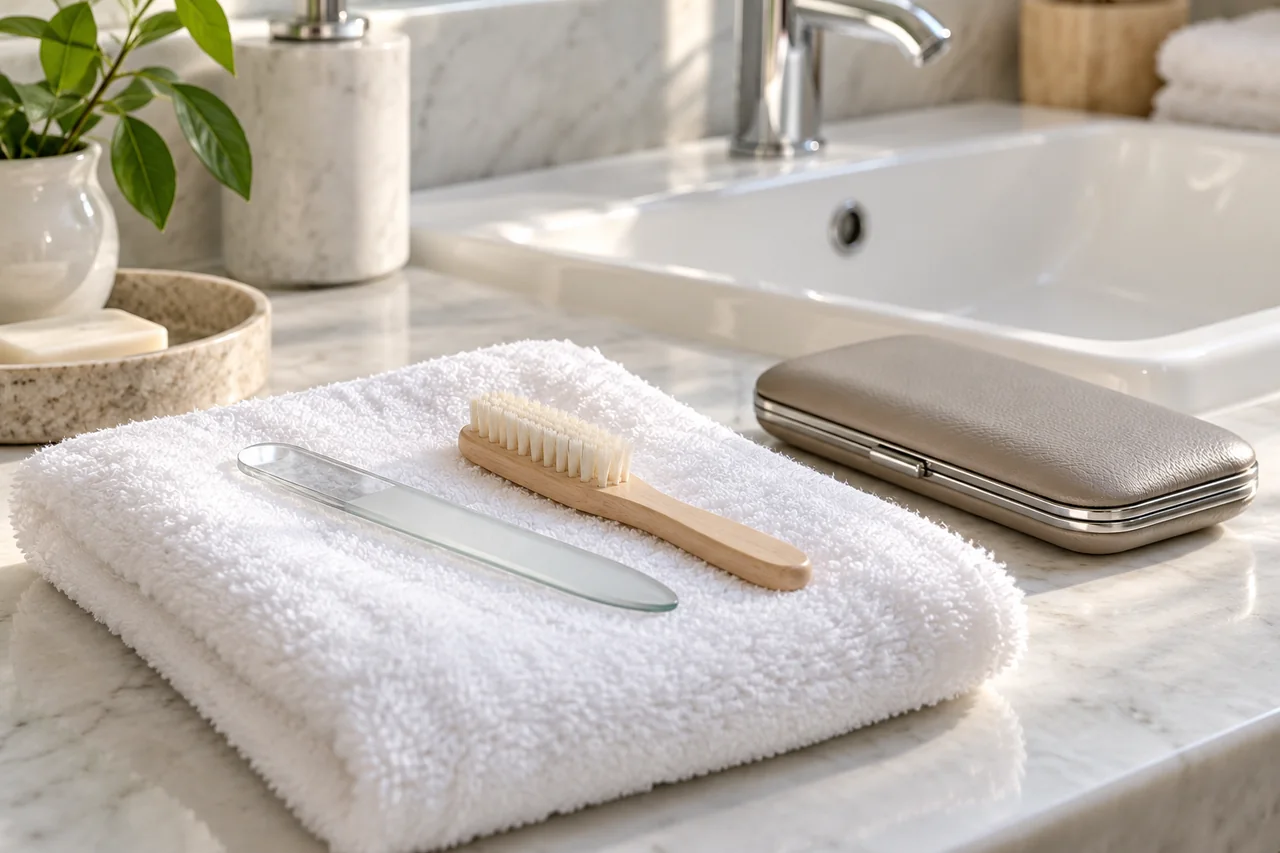
A clear personal tool routine combines suitable care instructions with straightforward organisation. A tidy box alone does not establish that its contents are ready to use.
Identify the tools you use
Set out only the items in your normal routine. A file, small brush and case are easier to manage than many unfamiliar metal tools. Record material and manufacturer where possible, check instructions and confirm the intended nail use. Damaged or unidentified objects need not be forced back into service through aggressive cleaning. This is a chance to remove unnecessary items.
Distinguish materials and single-use items
Glass, metal, coatings and porous disposable materials can need different handling. Do not transfer one file’s cleaning method to another without checking. Read which agents and steps are intended and whether reuse is permitted. Wiping a disposable item does not make it permanently reusable. A household spray is not a universal substitute. Ask for missing guidance or choose a clearly documented replacement.
Separate used from prepared items
Give used tools a designated place so they do not go straight back among prepared items. Follow each tool’s care directions, including any drying stage, before storage. A small dish or a separate part of the mat can help. Label storage if necessary, not the contact surface. This is a manageable personal routine, not an improvised reproduction of a professional reprocessing facility.
Do not equate cleaning with sterilisation
A visibly clean item is not automatically sterile; the terms describe different states and procedures. Rinsing, spraying or a closed attractive box does not justify a sterility claim. If a tool contacted blood or an abnormal skin area, this simple organisation guide does not establish how it can safely be reused. Obtain appropriate professional advice rather than claiming certainty from a household remedy.
Keep personal ownership clear
Use a dedicated case or labelled container when several people share a drawer. If you want to take personal tools to a salon, ask beforehand how it handles them. Owning the tools does not replace the salon’s professional hygiene process. Discuss it instead of assuming everything in a bag can be used immediately.
Use storage as a condition check
Choose a suitable dry place as directed and protect surfaces from loose keys or other bag contents. Before use, ask: is this my tool, is it in good condition, and was it cared for as intended? Resolve uncertainty first.
When replacing tools, compare maintenance needs, stated useful life and disposable components as well as price. A large cheap set with unclear materials may be less practical than a few documented tools. Keep instructions accessible and check the replacement model rather than automatically carrying over the old cleaning routine.
Frequently asked questions
Is wiping enough for every tool?
No. The material and intended use matter. Follow manufacturer guidance and do not claim sterility after a simple wipe. Treat disposable and reusable items differently.
Can I share tools with family members?
Clear personal allocation makes a home routine easier to manage. A shared drawer should not allow used and prepared tools to become confused.

Questions and experiences
Share a question or a useful experience about this topic. Every contribution is checked before publication. Comments may be written in different languages.
Loading reader contributions…
Opening the form sets a necessary session cookie. No email address is required. Publication is subject to moderation and is not guaranteed. For deletion requests: Contact