
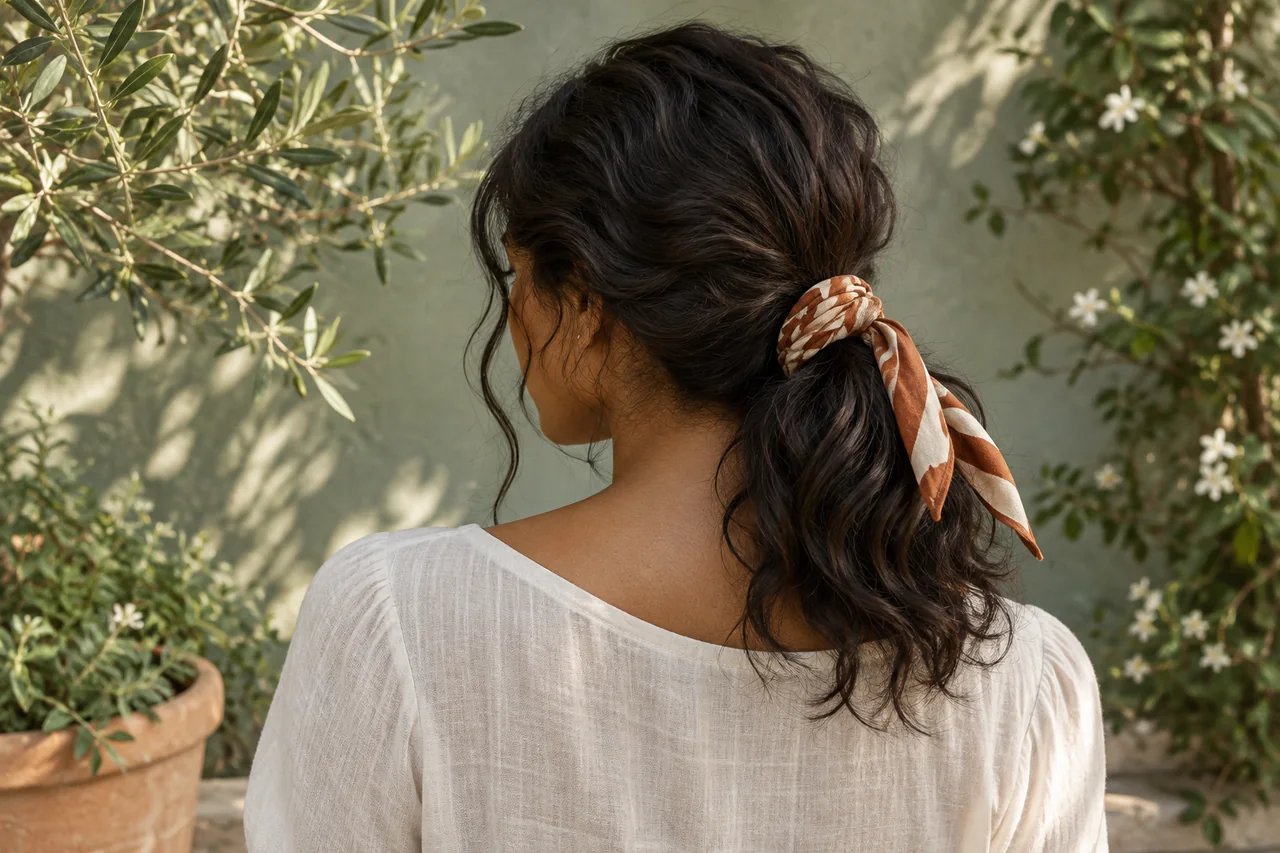
A ponytail need not capture every short strand or sit at the same height for every activity. Begin by holding the hair in different positions and choose a fastening that works without repeated tightening.
Test height by hand
Gather loosely at the nape, turn and lower your head, then compare a middle position. For a high ponytail, short nape sections must reach comfortably; otherwise leave them free or choose lower. Include collar, glasses, headphones and the activities ahead.
Choose the band by function
Use an intact smooth-feeling band that does not catch hair. Too loose slips; too tight requires unnecessary force. A fabric cover alone guarantees no suitable fit. Support the base while fastening, and change the band or style if the final wrap needs strong pulling.
Arrange the surface without retightening
Let the ponytail hang and adjust individual areas with fingers. Repeatedly splitting and pulling it apart can increase tension. If the position is wrong, release and restart. Small waves are allowed. The AAD links repeatedly tight styles with traction-related hair loss; release painful styles and seek dermatological assessment for noticed hair loss.
Check weight in real activities
Notice after a while whether you alter posture or touch one spot repeatedly. A low ponytail may hit a collar; a middle one may collide with a headrest. For sport, prevent loose parts catching equipment and hard accessories pressing. Different situations can require different positions.
Investigate slipping precisely
Determine whether the band stretches out or the whole section moves. Replace worn bands or change size for a small section. Product residue may affect handling, but stronger product is not automatically the answer. Note hair condition, band and position, then change one factor.
Choose an everyday standard
Hypothetically, a high ponytail becomes uncomfortable at a desk, a middle one hits the chair and a low one remains comfortable. The low version becomes the work standard. Other comfortable positions can remain for occasions. Keep a tested spare band and remove it gently rather than dragging it through tangles.
Make a fair two-day comparison
Use the same familiar band and work conditions, changing only height. Record comfort, adjustments and headrest contact. A less photogenic but more comfortable version may be the better work choice. This identifies a personal solution rather than proving one universally best height.
Frequently asked questions
Is a high ponytail always unsuitable?
No. Tension and comfort matter. If the available length reaches only under strong pulling or discomfort appears, choose another position.
Should I use the same spot every day?
You can alternate comfortable positions and loose styles. Avoid repeatedly tightening an uncomfortable arrangement out of habit.

Questions and experiences
Share a question or a useful experience about this topic. Every contribution is checked before publication. Comments may be written in different languages.
Loading reader contributions…
Opening the form sets a necessary session cookie. No email address is required. Publication is subject to moderation and is not guaranteed. For deletion requests: Contact