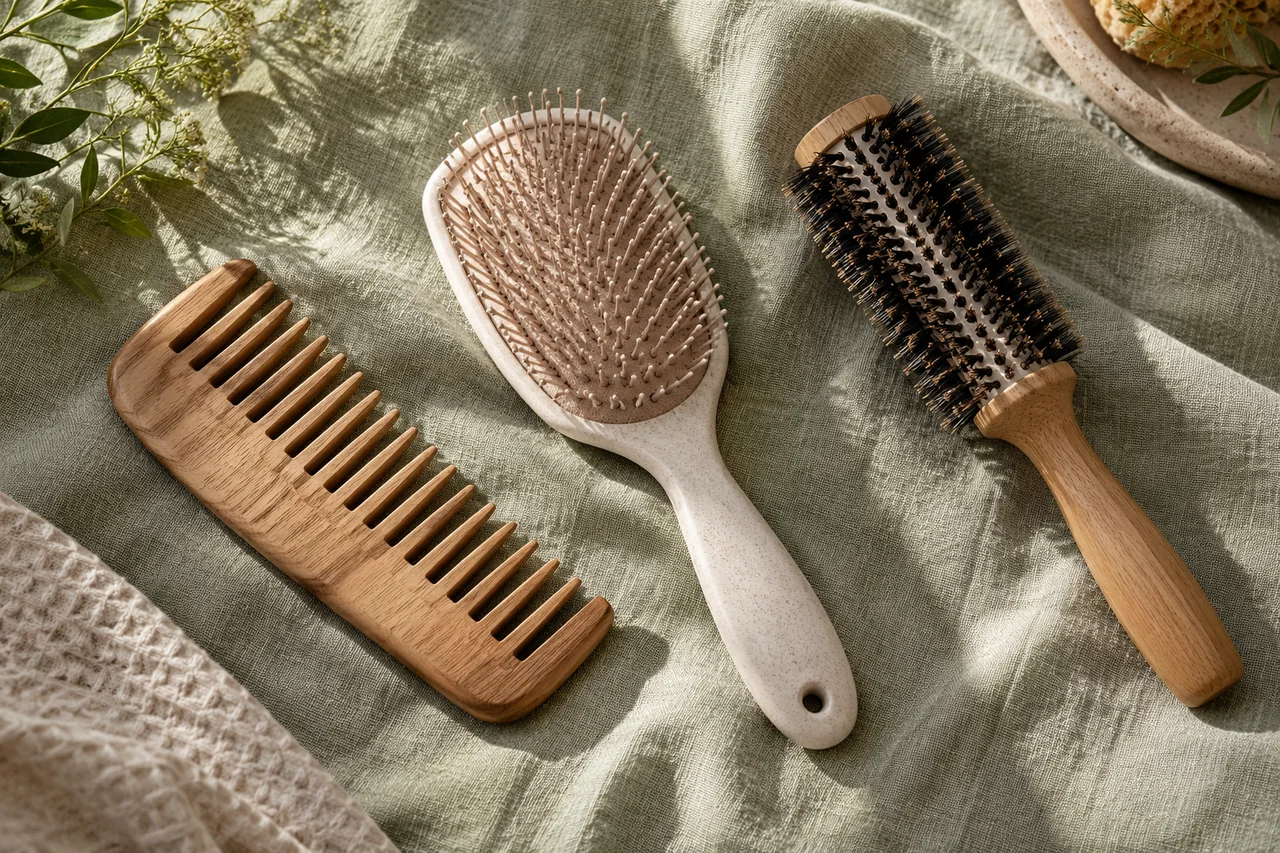
Detangling, defining a parting and shaping ends are different jobs. Start with the task, then check which of your existing tools handles it comfortably.
Name the actual job
Lay out your tools and give each a specific role. “For separating sections” or “for shaping ends while drying” is more useful than “for all hair”. A wide-toothed comb or fingers may help careful detangling; a suitable brush or comb may arrange the surface; a round brush may guide a bend; a smooth comb can define a parting. An unused tool does not need replacing simply because it is unused.
Inspect the comb
Check teeth and the spine carefully with your fingers. Stop using tools with rough edges, burrs or damaged tips. Tooth spacing affects handling. The American Academy of Dermatology includes a wide-toothed comb among gentle detangling tools, but that is not permission to force it through a knot. A fine-toothed side may arrange the surface without being the right first tool for tangled lengths.
Try detangling brushes carefully
Consider bristle flexibility, spacing, shape and grip, and check whether the brush is intended for the hair condition in which you will use it. Test a small visible section, supporting the length above the area being untangled. If it repeatedly catches, change the section size, method or tool. Flexible bristles do not make fast, forceful strokes appropriate.
Use a round brush as a shaping tool
Match its diameter and your available hair length to the intended bend. Begin with small manageable sections and movements you can release at any time. Do not wrap on more hair when you can no longer control the ends. If hair catches, turn off the dryer and release it calmly. A flat brush or fingers may already produce the everyday result you want.
Clean and store appropriately
Remove loose hair and clean according to the material and manufacturer guidance. Not every wooden or cushioned brush should soak in water. Let cleaned tools dry fully and check bristles, teeth and handles. Do not put a damp brush straight into a bag. A small travel tool with one clear purpose can be enough; a useful collection is one you can keep clean and ready.
Buy only for an observed gap
Complete the sentence “My current tool struggles with…” before shopping: perhaps the grip is uncomfortable or a small area is difficult to reach. Compare features relevant to that job. Price, material and endorsements do not establish a benefit for your routine. Inspect in person if possible, then judge several ordinary uses.
For a stock check, lay everything on a towel and remove damaged items from use. Select a detangling tool and a shaping tool if both are needed. Try that small selection several times. If something remains difficult, check existing alternatives before buying. Keep tools as daily essentials when you can describe their real advantage.
Frequently asked questions
Do I need a new brush for every hairstyle?
No. Define the job and check whether a tool you own can do it. A specialist design is useful when it makes a specific action easier.
Must I brush my hair for a long time every day?
No. The AAD advises against routinely using many brush strokes. Brush for a particular styling purpose and avoid unnecessary repetition.


Questions and experiences
Share a question or a useful experience about this topic. Every contribution is checked before publication. Comments may be written in different languages.
Loading reader contributions…
Opening the form sets a necessary session cookie. No email address is required. Publication is subject to moderation and is not guaranteed. For deletion requests: Contact