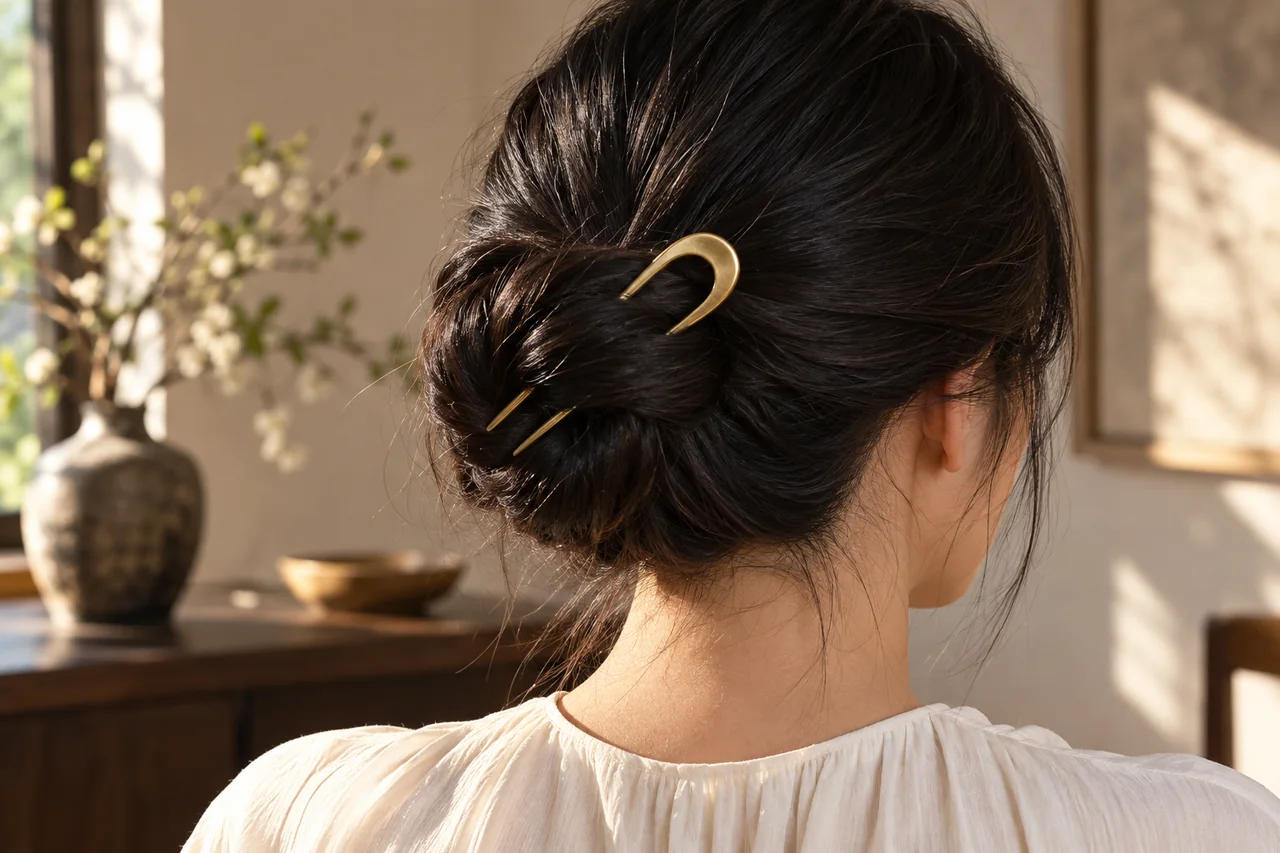
A U-shaped French pin should hold hair without pressing into the scalp. Its placement needs to catch both the knot and some hair beneath it. Begin slowly with a manageable amount of hair instead of using extra force to compensate for a poor fit.
Match the pin to the hair
Check smooth, undamaged surfaces and comfortable tips. A tiny pin may be lost in a large knot; a long one may project from little hair. Make a loose low loop first. If length is insufficient, use a half-up section or another fastening rather than twisting increasingly tightly.
Support the knot
Lay the length loosely around its starting point and hold the knot flat without pulling the front hairline. Leave ends visible initially; practise hold before concealment. Two mirrors can help, but briefly feeling the shape with fingers may be easier than interpreting reversed movement continuously.
Practise the reversal
Catch a small section at the outer edge with the prongs briefly pointing away from the centre. Turn the pin back towards the knot, then gently slide it beneath the shape while catching a shallow section of hair underneath. These two layers provide hold. If there is resistance or pressure, remove it and restart with less edge hair.
Test ordinary movement
Release your supporting hand gradually, turn your head, look down and sit. The pin should not migrate or hit the nape. Check a usual headrest carefully and remove the pin before activities where it could press or catch. A soft tie may be more practical for some situations.
Distinguish slipping causes
If the whole shape moves, the pin may have caught too little underlying hair. If only ends escape, leave them deliberately visible or use less hair. A heavy shape may need another fastening. Product cannot automatically correct the angle. Photograph a successful back position for reference. If a tip presses, release the pin immediately and try a flatter angle or a different comfortable model rather than pushing it farther in.
Add another version gradually
Once a low knot works, change only its position slightly sideways. A high knot changes hand position and weight, so it need not be the next step. Record pin, hair amount and placement. Two comfortable successes in three calm attempts can be a useful personal goal, without copying someone else’s demonstration speed.
Use a half-up practice version
Bring two broad side sections together, form a small flat knot and repeat the edge-and-underlying-hair movement. If the pin projects because it is too long for the amount, choose a smaller suitable fastening. This separates learning the movement from supporting all your hair.
Frequently asked questions
Can a French pin work with short hair?
Sometimes in a small half-up section. If there is insufficient length for a knot, clips may be easier. Pulling harder cannot create missing length.
Do I need an expensive pin?
Smoothness, comfortable tips and a suitable shape matter more than price or material name. A practical wearing test is the useful check.


Questions and experiences
Share a question or a useful experience about this topic. Every contribution is checked before publication. Comments may be written in different languages.
Loading reader contributions…
Opening the form sets a necessary session cookie. No email address is required. Publication is subject to moderation and is not guaranteed. For deletion requests: Contact