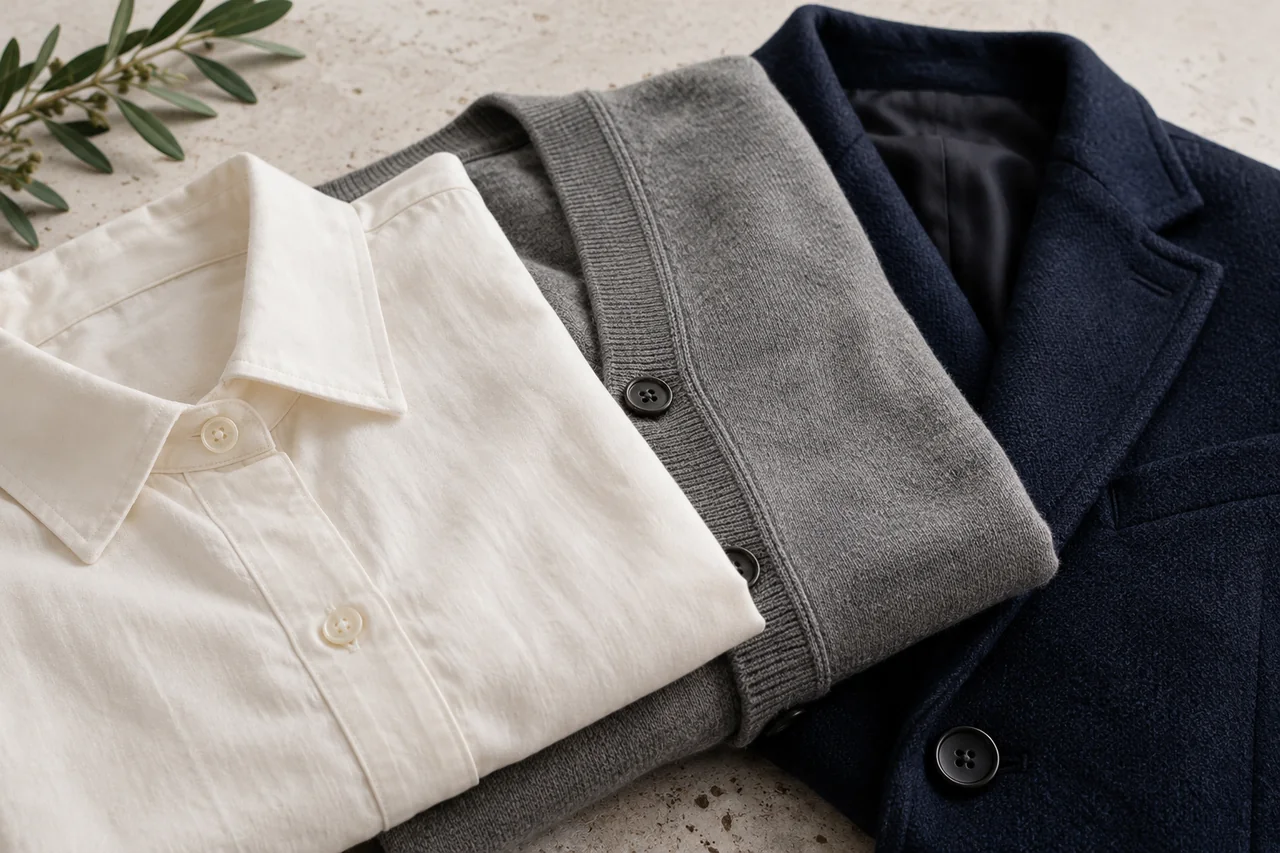
Contrast belongs to the relationship between areas, not to one garment alone. Changing a neckline, shoe or jacket can alter the overall effect. Look at the whole outfit as well as the colours next to your face.
Separate hue from lightness
Pale and dark blue share a colour family but create strong light-dark contrast. Medium blue and green may differ more in hue. Digital colour models separate hue, lightness and chroma; you need no calculations to use the same practical distinction with fabrics.
Build three contrast levels
Pair a light top with dark, medium and light trousers while keeping other pieces similar. The first divides the outfit strongly; the last creates a more continuous area. None is universally better. Choose according to occasion, preference and the pieces you want visible.
Review the frame near your face
Hair, glasses, collar and neckline work together. A dark roll-neck creates a different frame from an open neckline or pale shirt. Try a small light collar under dark knitwear before replacing the outfit. No skin colour permits only one approach.
Use smaller contrasting details
A belt, narrow stripe, bag or shirt hem can introduce contrast without a large jacket-sized area. Start with one detail. Several light accents may draw attention in competing directions; remove one and compare the result.
Use photographs cautiously
A greyscale image can suggest which areas appear similarly light, but exposure and conversion influence it. Compare photographs made consistently and confirm in the mirror. Shine, movement and actual colour are missing or distorted; a bright reflection does not make a dark fabric inherently pale.
Frequently asked questions
Must clothing repeat my hair-skin contrast?
No. Natural features may inspire an outfit, but you can choose similar transitions or a deliberately stronger frame.
Is low contrast boring?
Not necessarily. Texture, shape and cut can provide interest. If more structure is wanted, try one different material or lightness level before adding another bright colour.


Questions and experiences
Share a question or a useful experience about this topic. Every contribution is checked before publication. Comments may be written in different languages.
Loading reader contributions…
Opening the form sets a necessary session cookie. No email address is required. Publication is subject to moderation and is not guaranteed. For deletion requests: Contact