
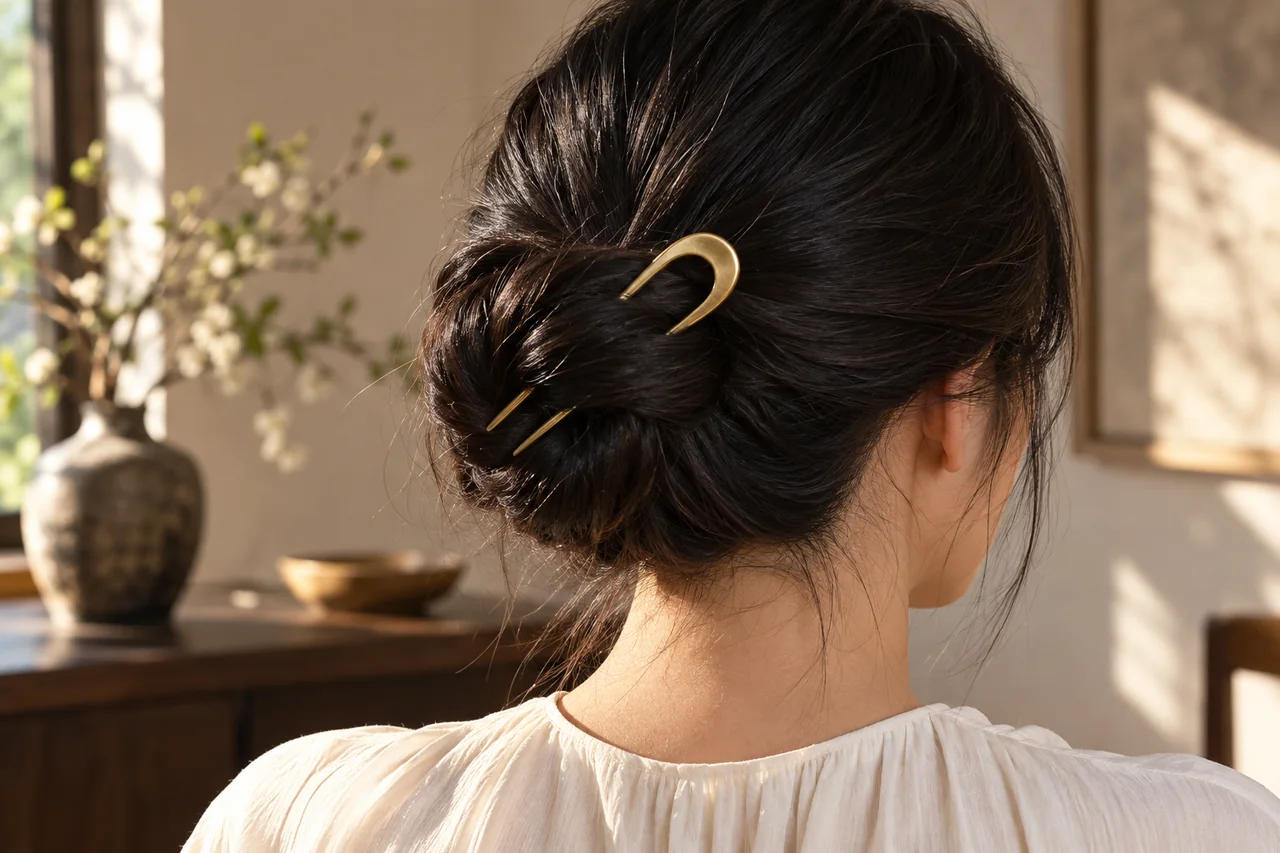
A French twist forms a long roll against the back of the head. Start with the direction and hand positions before trying to hide every end. Short or very long hair may need a modified shape, and the first practice need not be worn outside.
Assess the available length
Gather loosely at the nape and lift upwards. Can a roll form without pulling the sides? A short bob may allow only a partial style; very long hair leaves more to tuck. Prepare smooth pins you can handle and allow a calm practice period without an appointment deadline.
Build the roll in one direction
Support the base and loosely twist upwards into an elongated shape against the head. Keep the sides comfortable; a perfectly smooth top is unnecessary. If it springs apart, use less hair or a small upper section to learn the movement. Extra force does not clarify the technique.
Arrange the remaining ends
Gently fold projecting ends downward beneath the open edge. Distribute very long excess along the roll rather than packing it all at the top. Choose another style if the roll becomes too bulky. Shorter ends may deliberately remain visible as a soft finish.
Secure the seam
Hold the roll, catch a small amount at its open edge with a pin, then guide the pin back underneath to include hair near the head. Add support only where needed without pressing tips into the scalp. Release your hand slowly and correct the area that actually opens rather than forcing one very tight pin.
Choose a wearable version
A higher roll changes collar contact; a side part changes the front without replacing the basic technique. A softer version can allow short loose hairs. If a very smooth formal result matters before you have mastered it, discuss a professional style early with front and back references and expected wearing time.
Simplify the next attempt
Record at most two difficulties, such as a pulling side or loose top end. Change those rather than parting, height, product and pins simultaneously. Once it holds, test sitting and head movement. Count and remove pins individually. A style comfortable only for a short event still has a useful role.
Separate holding from fastening
First form and support a smaller roll for several seconds, then release and repeat. Next add one pin, followed by another only when the first sits comfortably. A less-polished shape you can safely remove yourself is a worthwhile learning result; concealing every tip can wait.
Frequently asked questions
Is a French twist the same as a bun?
No. A twist forms an elongated roll, while a bun arranges length around a centre. Fastening may be similar, but shape and weight distribution differ.
Must I backcomb first?
Not for this learning version. Try the basic shape and appropriate pins first. If it requires extensive manipulation to hold, another style may fit your hair more easily.

Questions and experiences
Share a question or a useful experience about this topic. Every contribution is checked before publication. Comments may be written in different languages.
Loading reader contributions…
Opening the form sets a necessary session cookie. No email address is required. Publication is subject to moderation and is not guaranteed. For deletion requests: Contact