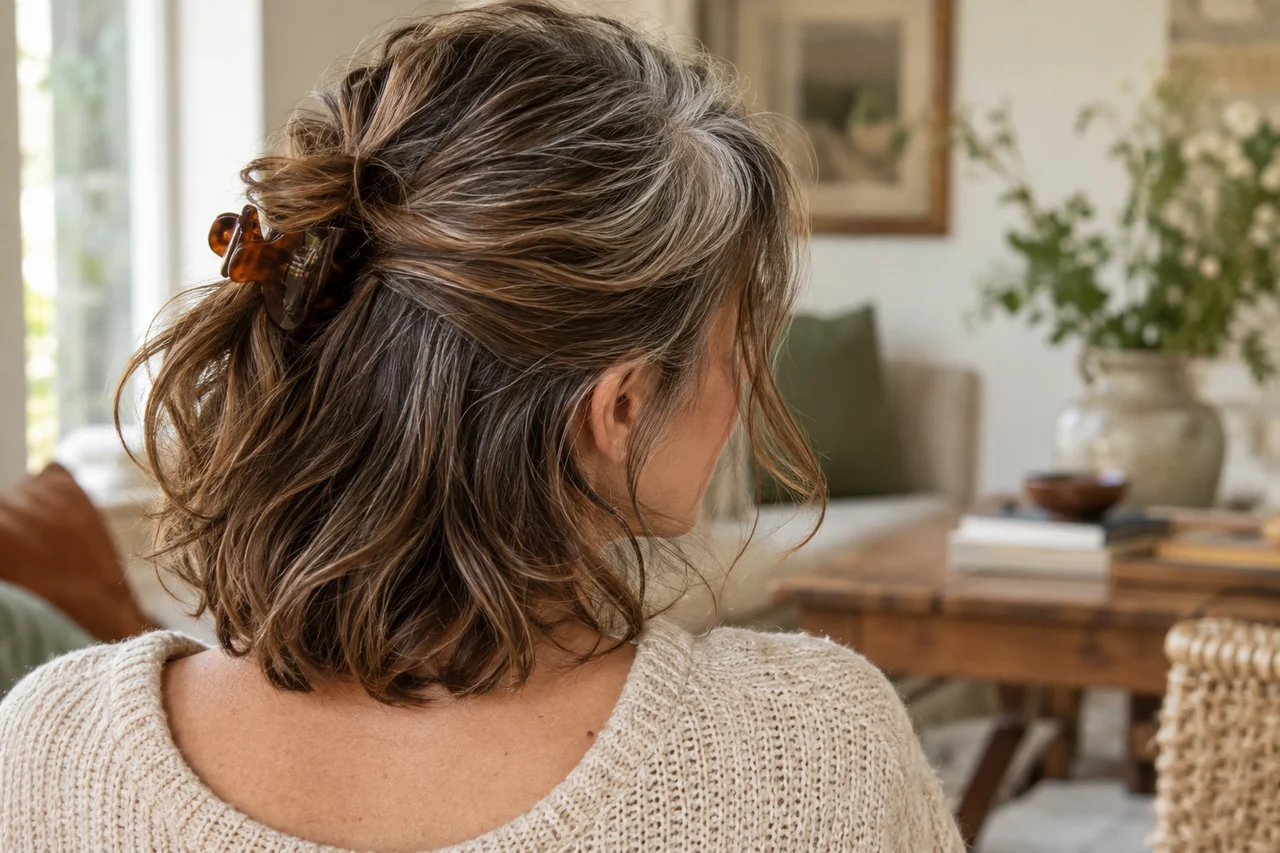
Growing out grey is a personal choice about appearance and everyday effort. You do not need to justify it through age or a rule about naturalness. Keep your main reason visible so later suggestions do not quietly replace the goal.
Name the reason for stopping colour
Fewer appointments, curiosity, a different appearance and a simpler routine may suggest different routes. Elaborate follow-up colouring may conflict with a wish for fewer visits; professional colour advice may help if a quiet transition matters most. Changing your mind later is allowed.
Treat length as a separate decision
A shorter cut can reduce the visible coloured area faster but also changes the hairstyle. If length matters, plan visible intermediate stages instead of assuming everything must be cut away. Temporary pinning may suggest a shorter outline but cannot reproduce the final cut exactly.
Observe without judging every day
Use occasional photos in similar conditions if useful. Whole views show how colour works with shape, clothes and glasses better than constant close-ups of the parting. A different parting or loose pinned style changes visible areas; these are options, not duties to hide the roots.
Set small stages
Choose a next action such as trying another parting or removing a particular coloured area during a planned cut. Use review dates instead of an unsupported universal growth deadline. For an event, test a style with the current transition in advance; it need not automatically trigger full recolouring.
Keep the preferred bob while colour changes
Hypothetically, someone with a dark chin-length bob keeps the length, chooses only needed contour corrections and varies loose or pinned front sections as pale roots grow. Later they can reassess length and removal of old colour. This is a flexible example, not a promised duration.
Change care only for a real task
Grey hair does not require a large new product collection. Identify cleaning, detangling, styling or a particular tone issue and ask for suitable use. Keep successful routines initially. Before assuming clothes and make-up all need replacement, compare a few existing face-adjacent colours.
Frequently asked questions
How long until the old colour is gone?
Starting length, growth and cutting choices determine that. A precise general timeline would be unreliable; plan the next shape stage and review actual progress.
Can I simply tone all the old colour grey?
A uniform result cannot be promised across differently treated sections. Seek professional assessment if changing colour; growing out itself needs no added tint.
Must I change clothing or make-up?
No. Start with combinations you still enjoy and alter individual contrasts only if wanted. A hair change does not require replacing your belongings.



Questions and experiences
Share a question or a useful experience about this topic. Every contribution is checked before publication. Comments may be written in different languages.
Loading reader contributions…
Opening the form sets a necessary session cookie. No email address is required. Publication is subject to moderation and is not guaranteed. For deletion requests: Contact