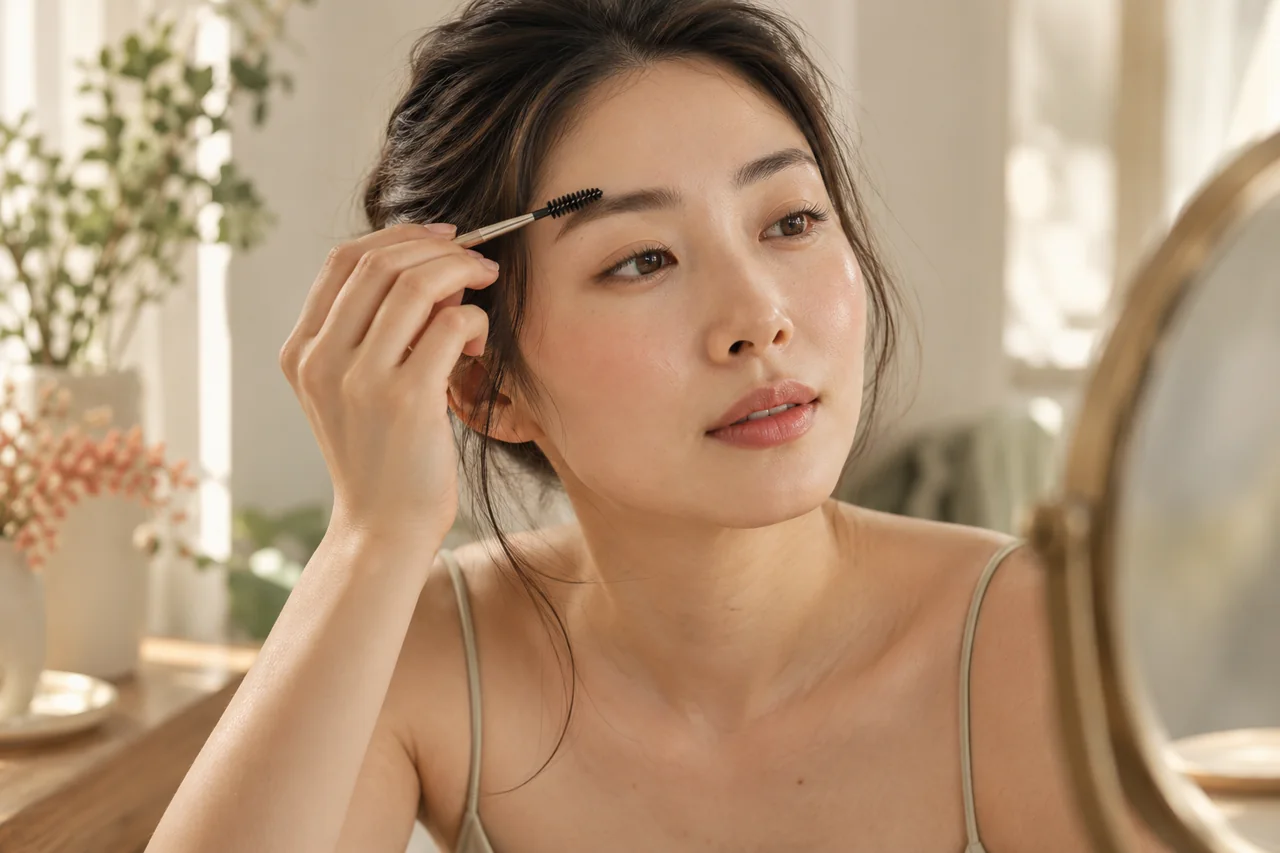
Natural-looking definition starts with the hairs you already have. You do not need to redraw the shape or make both sides identical. Brushing, a few short marks and a normal-distance check keep the result manageable.
Read the existing shape
Use a clean suitable spoolie to guide the hairs gently into place. A supposed gap may disappear when one hair moves. Distinguish sparse areas from paler hairs. A soft irregular boundary can look natural; this temporary routine requires neither plucking nor tinting.
Choose the tool for the task
A fine pencil makes short marks, powder adds soft shading and brow gel emphasises or holds existing hairs. Test colour beside your brows: matching head-hair depth does not prevent an overly warm effect. Start with one product that builds under light pressure.
Add only what is visible
Work on a gap you can see from normal distance. Make short strokes roughly along hair growth, leaving tiny spaces, then brush through once. The front can remain softer than the tail, but need not. If one stroke is too dark, reduce it instead of darkening everything else to match.
Set an achievable stopping point
Look at both brows with a relaxed face. Natural differences are expected. Alternating close-ups in a magnifying mirror can create an endless correction cycle. Aim for the most noticeable gap to be softened and the pair to feel balanced when talking, not perfectly identical.
Check glasses, daylight and comfort
For a pale patch in otherwise dense brows, a few marks in that area may replace full-brow filling; gel may be unnecessary. Note the useful placement for next time. View the result with your glasses without assuming a heavier frame demands darker brows. Remove products as directed. Discomfort from a new formula is not a reason to repeatedly apply more.
Frequently asked questions
Must brows match my head-hair colour?
Not necessarily. Existing brow colour and your intended intensity matter, particularly when head hair is dyed. Compare directly on the face.
Do I need a stencil first?
Usually not for small gaps. A stencil imposes a predefined shape; start with your own brow line and expand only for a specific styling aim.
Questions and experiences
Share a question or a useful experience about this topic. Every contribution is checked before publication. Comments may be written in different languages.
Loading reader contributions…
Opening the form sets a necessary session cookie. No email address is required. Publication is subject to moderation and is not guaranteed. For deletion requests: Contact