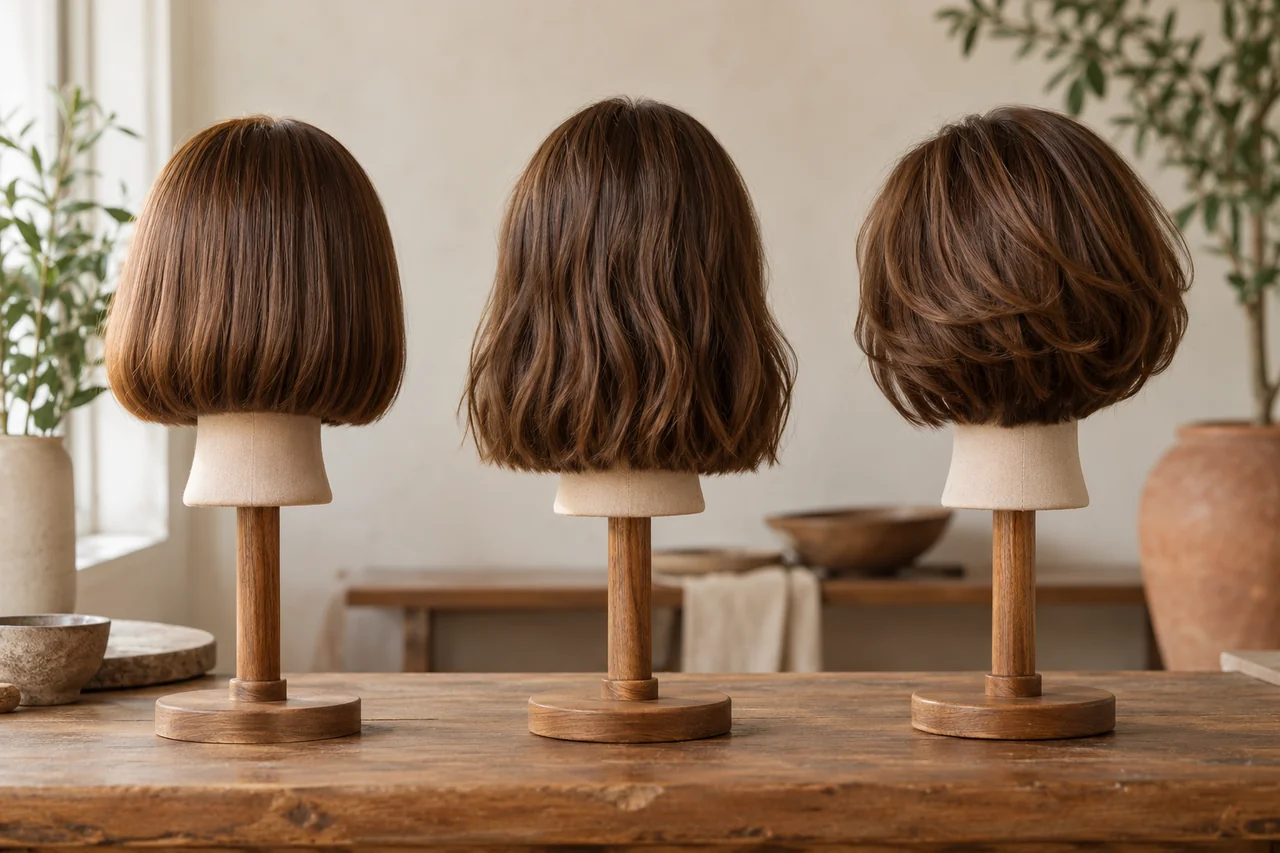
Bob names can hide substantial differences in length, layering and finish. Comparing the parts gives you a clearer salon brief than choosing a trend word alone. You do not need a particular face-shape label to explore the options.
Describe the outer line
Look beyond colour, make-up and clothes. Is the edge straight, rounded or longer towards the front? Does it end near the chin or shoulder? Describe the visible shape before calling it modern or flattering. Its effect depends on the version you enjoy and your own hair movement.
Measure length against functions
Consider head, neck and shoulder rather than a standard bob measurement. Demonstrate tucking, partial pinning or full tying. A long-bob label does not guarantee that front pieces reach your usual ponytail. Include scarves or high collars that affect how you like the ends to sit.
Separate edge from layers
A compact outer edge can coexist with internal movement, depending on shorter sections. Waves in a photograph can obscure this. Ask which effect comes from cutting and which from styling. Specify whether movement belongs at the back, sides or face rather than requesting layers in general.
Compare names through a shared framework
French and Italian bob are search terms, not binding plans. Record each picture’s length, contour, front section and finish. If two images mainly differ because one is waved and one straightened, you may want styling alternatives rather than a permanent length change.
Decide on a fringe independently
Review forehead openness, parting and glasses. Imagine the front pinned away: do you still like the underlying bob? A short full fringe and long side pieces have different practical needs. If only the front attracts you, a smaller targeted change may be sufficient.
Combine compatible preferences
Hypothetically, Milan likes the calm edge of a longer smooth bob and movement near the cheeks in a shorter wavy image. A longer compact base with a separately discussed front section may capture both priorities. The salon still needs to explain which movement requires styling.
Create a short comparison card
Use no more than three images and mark one essential and one unwanted feature on each. Include normal parting and shortest-section questions. Agree on a simple daily version and when the desired contour may need reviewing, rather than adopting a universal appointment interval.
Frequently asked questions
Which bob is easiest to maintain?
It depends on structure, routine and how precise you want the edge. Compare the everyday shape and follow-up visits together.
Can a bob work with natural waves?
Yes. Show your normal waves and discuss the visible dry length in that form. A straightened reference does not fully describe the wavy result.
Does an angled bob automatically have more layers?
No. A front-lengthening outline describes the outer edge; internal layering is a separate choice. Ask the stylist to explain both.



Questions and experiences
Share a question or a useful experience about this topic. Every contribution is checked before publication. Comments may be written in different languages.
Loading reader contributions…
Opening the form sets a necessary session cookie. No email address is required. Publication is subject to moderation and is not guaranteed. For deletion requests: Contact