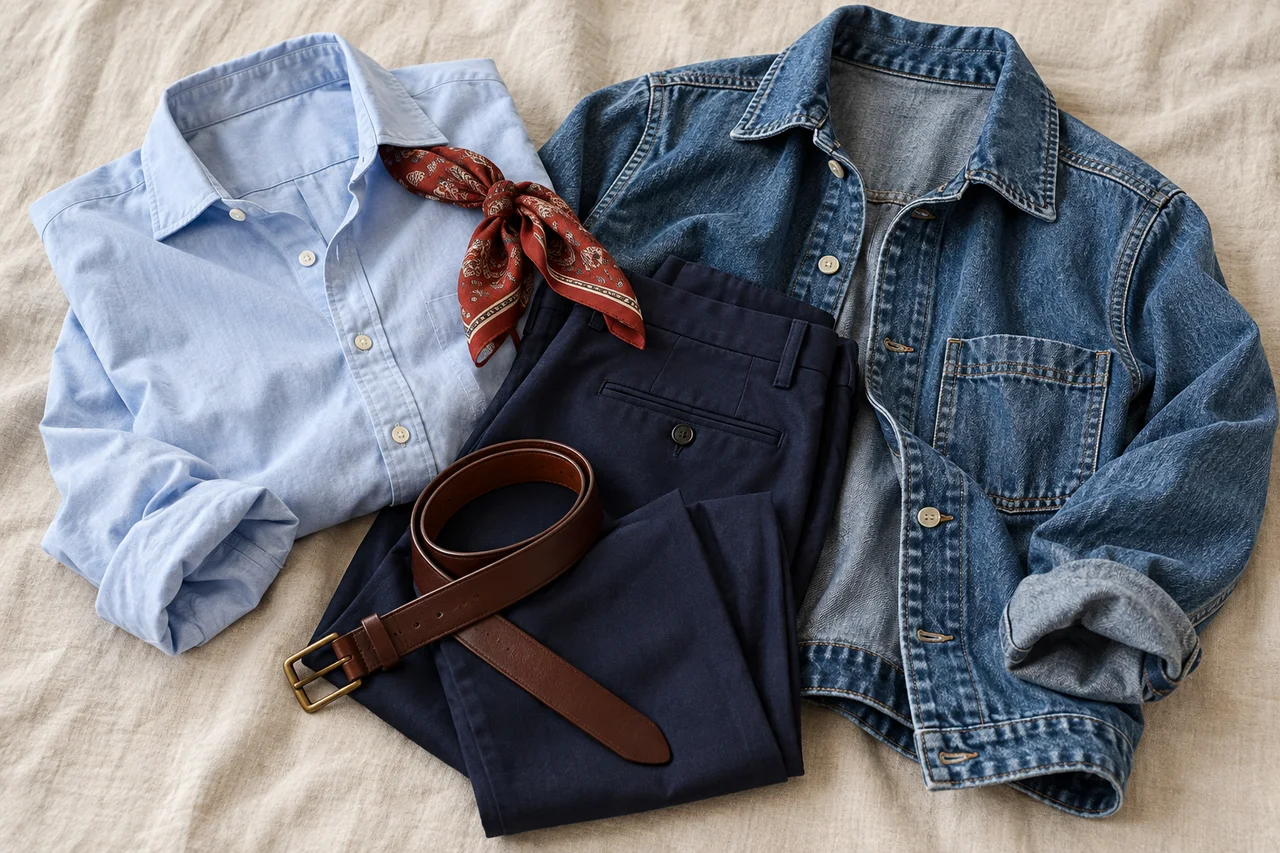
Blue offers more than one dependable formula. Its depth, clarity and fabric change how it works with other colours. Compare actual garments and decide whether you want a close connection or a clear difference.
Choose navy consciously
Check whether existing navy pieces are clear, greyed or almost black. A lighter shirt makes a simple contrast with dark trousers. Different surfaces can make near shades look intentional; for a uniform formal suit, coordinated fabric is easier.
Give denim more partners
Cream with brown accessories, sage or clear red all offer alternatives to white, black and grey. Washing and cut matter. Strongly faded denim already contains visual variation, so a plain top can clarify it; even dark denim leaves room for pattern.
Let two blues differ visibly
Pale blue with navy is easy to read. Two mid-blues may lean green and violet differently. Increase the lightness difference or separate them with cream if the pairing feels unclear. Texture can also make variation deliberate.
Assign one colour partner
Light blue with chocolate differs from navy with cognac. Blue-green can feel related, while blue-red creates a stronger counterpart. Test one partner at a time and choose its area according to the actual outfit, without a universal percentage rule.
Compare white with cream
Crisp white creates a bright, graphic contrast; cream can soften it and connect brown accessories. Try both with the same trousers. Check transparency, fabric, care and comfort too, because a theoretically suitable shade cannot make an unwanted shirt useful.
Frequently asked questions
Can navy and black be worn together?
Yes. A visible depth or texture difference helps the intention read clearly. Check normal room light, where very deep colours may merge.
Which blue suits every skin colour?
There is no single shade everyone must prefer. Skin depth does not determine a palette; compare lightness and intensity in the intended outfit.


Questions and experiences
Share a question or a useful experience about this topic. Every contribution is checked before publication. Comments may be written in different languages.
Loading reader contributions…
Opening the form sets a necessary session cookie. No email address is required. Publication is subject to moderation and is not guaranteed. For deletion requests: Contact