
Beige covers many shades, from sand to milky coffee and grey-leaning tones. A useful combination depends on the fabric beside it. Aim for a relationship you like rather than an elusive universal beige match.
Compare yellow, pink and grey directions
Small shifts become visible when fabrics sit together in steady light. Memory is unreliable for exact matching, and online lighting or processing adds uncertainty. Plan a real comparison before building an important outfit around a purchase.
Choose matching or gradation
A suit in one fabric may aim for uniformity. Separates can use cream, medium beige and a deeper brown detail. If two near-matches bother you, change one clearly rather than adding a third almost-matching shade.
Create depth through surfaces
Smooth cotton, relaxed knitwear and a textured bag can provide interest at similar lightness. More texture is not always better; a chunky jumper may need only plain trousers. Step back to check whether pieces remain distinct and whether the eye has a resting point.
Add colour deliberately
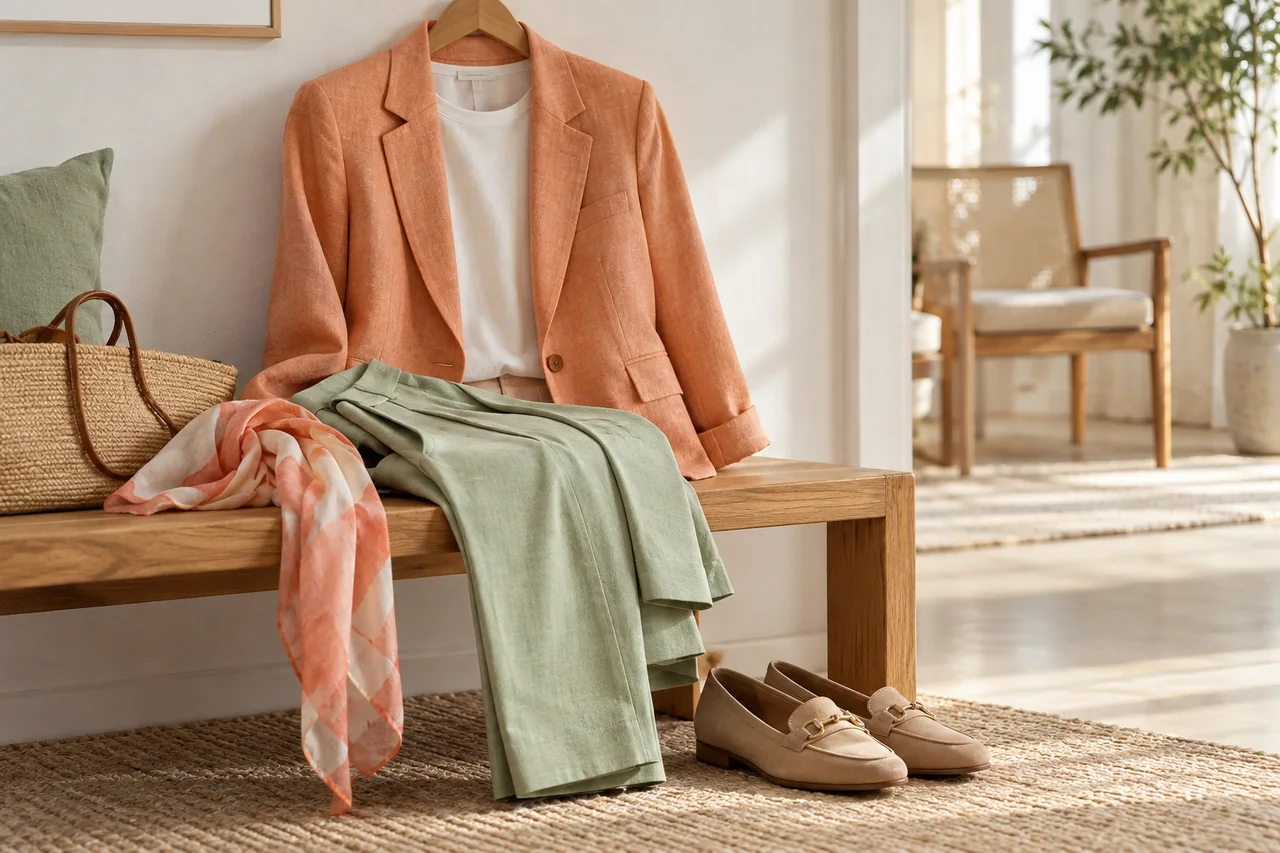
Blue offers a clear counterpart, muted green continues softness, and red or pink adds presence. Decide whether the accent is small or occupies a large area. Compare actual shades: an intentional warmth contrast may be more interesting than uniform temperature.
Check everyday practicality
Transparency, care and likely marks influence whether a pale garment gets worn. A slightly deeper beige may suit your routine better. Include the real coat and shoes, not only a summer arrangement that has no useful outer layer.
Frequently asked questions
Can beige and white go together?
Yes. White creates a clearer light contrast, while cream connects more softly. Try both with the same shoes to isolate the difference.
Which jewellery colour works with beige?
Gold and silver can both work. Consider the exact beige, jewellery size, finish and your preference rather than metal colour alone.


Questions and experiences
Share a question or a useful experience about this topic. Every contribution is checked before publication. Comments may be written in different languages.
Loading reader contributions…
Opening the form sets a necessary session cookie. No email address is required. Publication is subject to moderation and is not guaranteed. For deletion requests: Contact