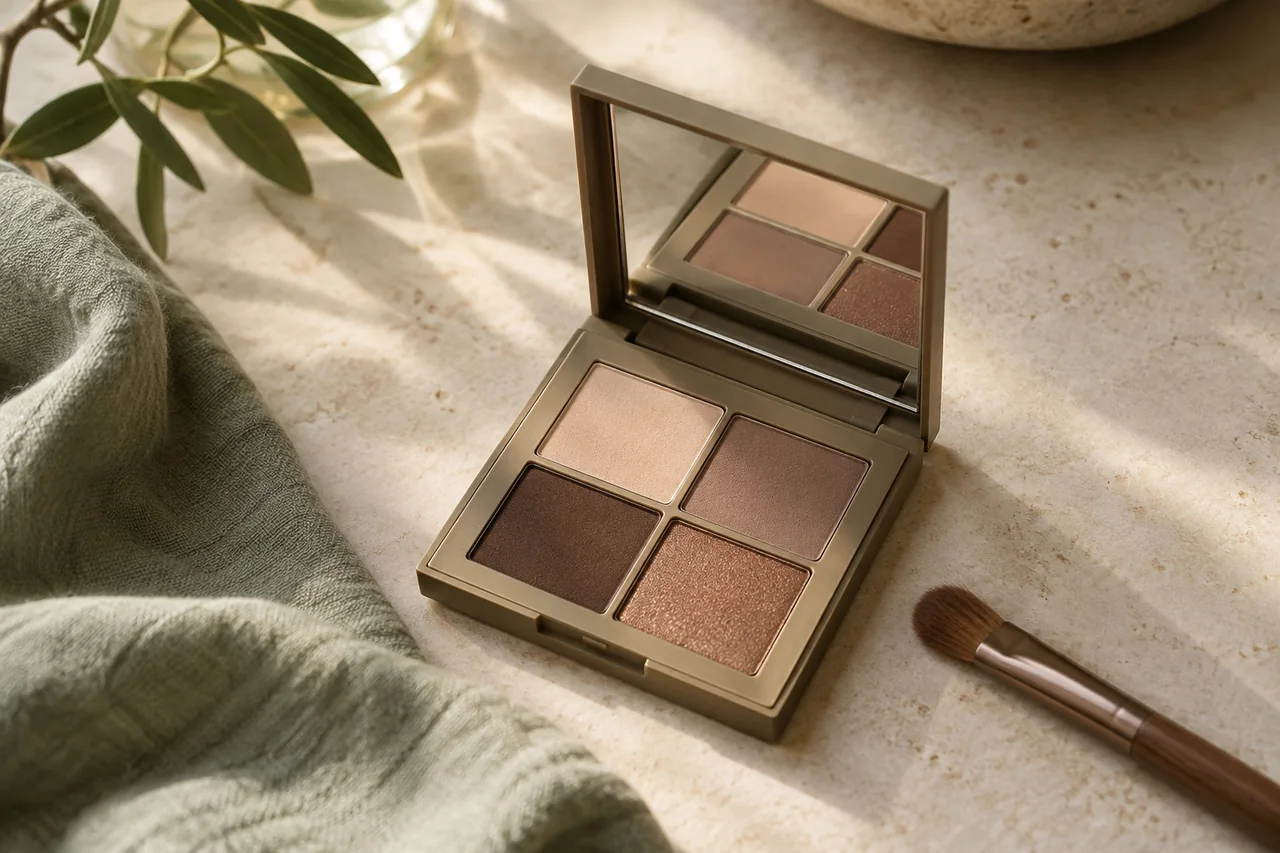
Neutral need not mean twelve beiges or barely visible make-up. It describes a useful role: colours you can combine without rethinking everything. Brown, taupe, grey and muted rose can all fulfil it. Start with your applications, then identify a genuine gap.
List the jobs you use
You may want a soft lid colour, an occasional darker line and sometimes a reflection: three tasks, not a compulsory large palette. A person who wears one shade does not need transition colours for unused techniques. Sort existing products by the looks and time you actually want.
Choose appropriate depth
Pale shades are not universal bases. On deeper skin, medium and deep browns may form a quieter core, with pale colours as optional accents. A neutral routine on light skin can still be dark or graphic. Palette labels suggest roles; your visible result decides whether those roles apply.
Compare warm, cool and mixed
Bronze and reddish brown offer a warmer direction; taupe and grey-brown a cooler one. Mixed selections are valid too. Warm eye colour can coexist with cooler lips. Check whether several pans create differences so slight that you never notice them in use; distinct jobs matter more than theoretical completeness.
Distribute finishes deliberately
A main matte and one shimmer may cover your needs. Examine reflection from several angles, since a product photograph can understate shine under direct lighting. Do not buy a large palette solely for one appealing shade without asking whether the others would be used.
Build two repeatable looks
Try soft taupe for a quick version and the same shade with a deeper upper line for a bolder one. Bronze can optionally vary the second look. Write down and practise the steps. If something is missing, describe it precisely, such as a deep matte that blends with your brush, before shopping.
Frequently asked questions
Do I always need a very pale shadow?
No. A light patch or highlight is optional. If you do not want that effect, it need not occupy a place in your selection.
Are single shadows better than palettes?
Neither format is inherently better. Singles allow targeted additions; a small ready-made palette is useful when its colours fulfil your actual tasks.



Questions and experiences
Share a question or a useful experience about this topic. Every contribution is checked before publication. Comments may be written in different languages.
Loading reader contributions…
Opening the form sets a necessary session cookie. No email address is required. Publication is subject to moderation and is not guaranteed. For deletion requests: Contact