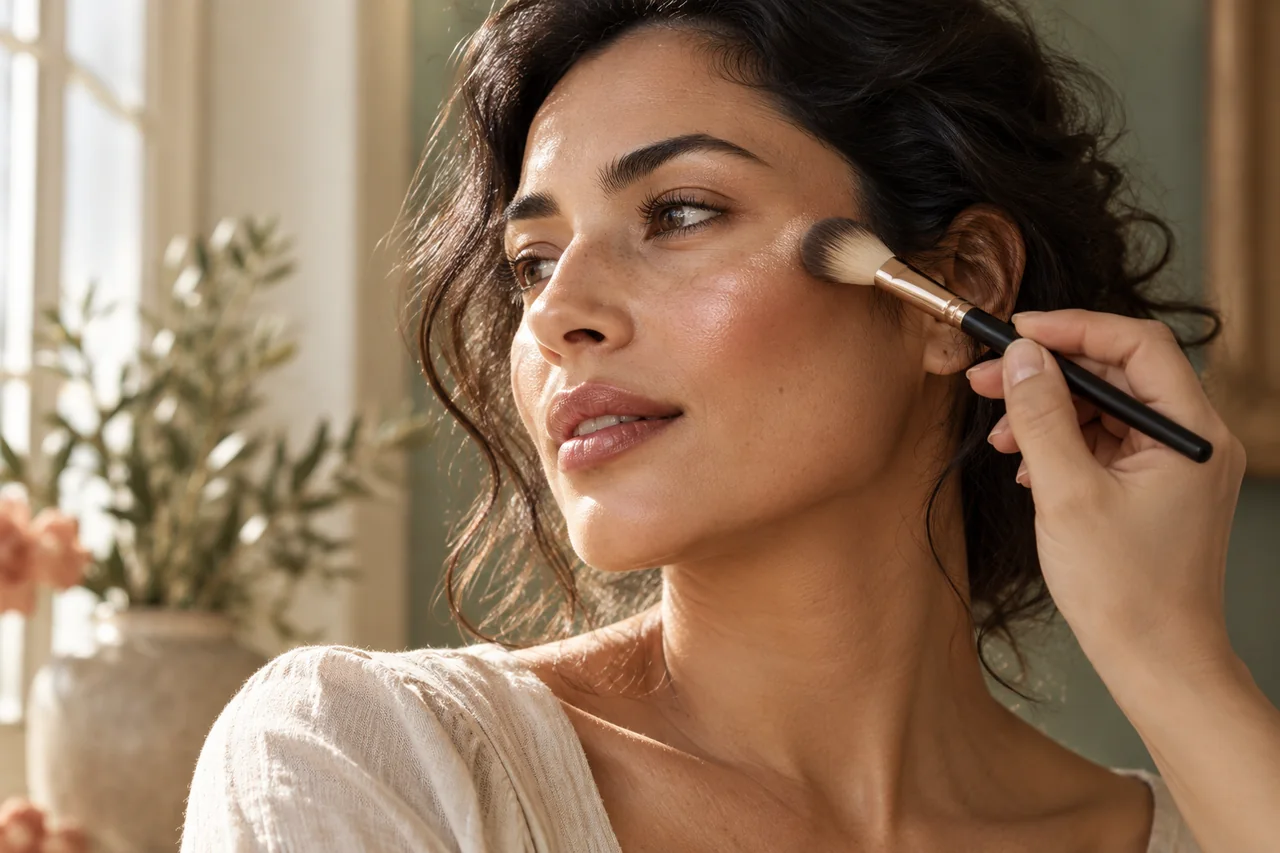
Highlighter draws attention through reflection or a glossy finish. You do not need a prescribed list of application points. A small accent can be sufficient, especially when you assess it under changing light.
Describe the reflection you want
Compare a small sample beside your foundation and move it in the light. Soft shimmer, obvious gloss and individual glitter particles are different effects. Packaging alone rarely shows their behaviour. Fine shimmer may be easier to control for a subtle start, without imposing age or skin-type rules.
Choose an area you enjoy emphasising
An upper cheek is one option, not a compulsory zone. Use products only in their intended areas. Initially skip a full sequence over nose, forehead, chin and lip bow. Reflection can make natural texture more noticeable; it does not remove unevenness.
Build from a small amount
Control the amount on a clean suitable surface or lightly loaded tool. Tap a suitable cream gently or use a small powder brush rather than a heavily loaded broad one. Repeated rubbing can move foundation. Recheck after each addition and stop once the accent appears in movement.
Let the other products count
Shimmery blush, bronzer or a luminous foundation may already provide the desired effect. Apply the colour products first and see whether anything is missing. Three reflective products over the same broad area can blur their individual purposes. A calm cheek is just as intentional as a glossy one.
Reduce excess where it occurred
If the reflection becomes too wide, soften or lift the unwanted edge with a clean tool. Heavy powder over the whole cheek changes the rest of the make-up too. If necessary, gently remove and rebuild only a small area. Check daylight and normal distance; for an event, test a photograph under similar conditions rather than copying a retouched product image.
Frequently asked questions
Which highlighter suits darker skin?
Check colour and depth on your own base. A very pale silver shade may remain a separate patch while another blends more softly. No single shade suits every darker skin tone.
Can it be eyeshadow?
Only if the product is intended for the eye area. Similar colour or texture does not establish suitable use; check its instructions.
Questions and experiences
Share a question or a useful experience about this topic. Every contribution is checked before publication. Comments may be written in different languages.
Loading reader contributions…
Opening the form sets a necessary session cookie. No email address is required. Publication is subject to moderation and is not guaranteed. For deletion requests: Contact