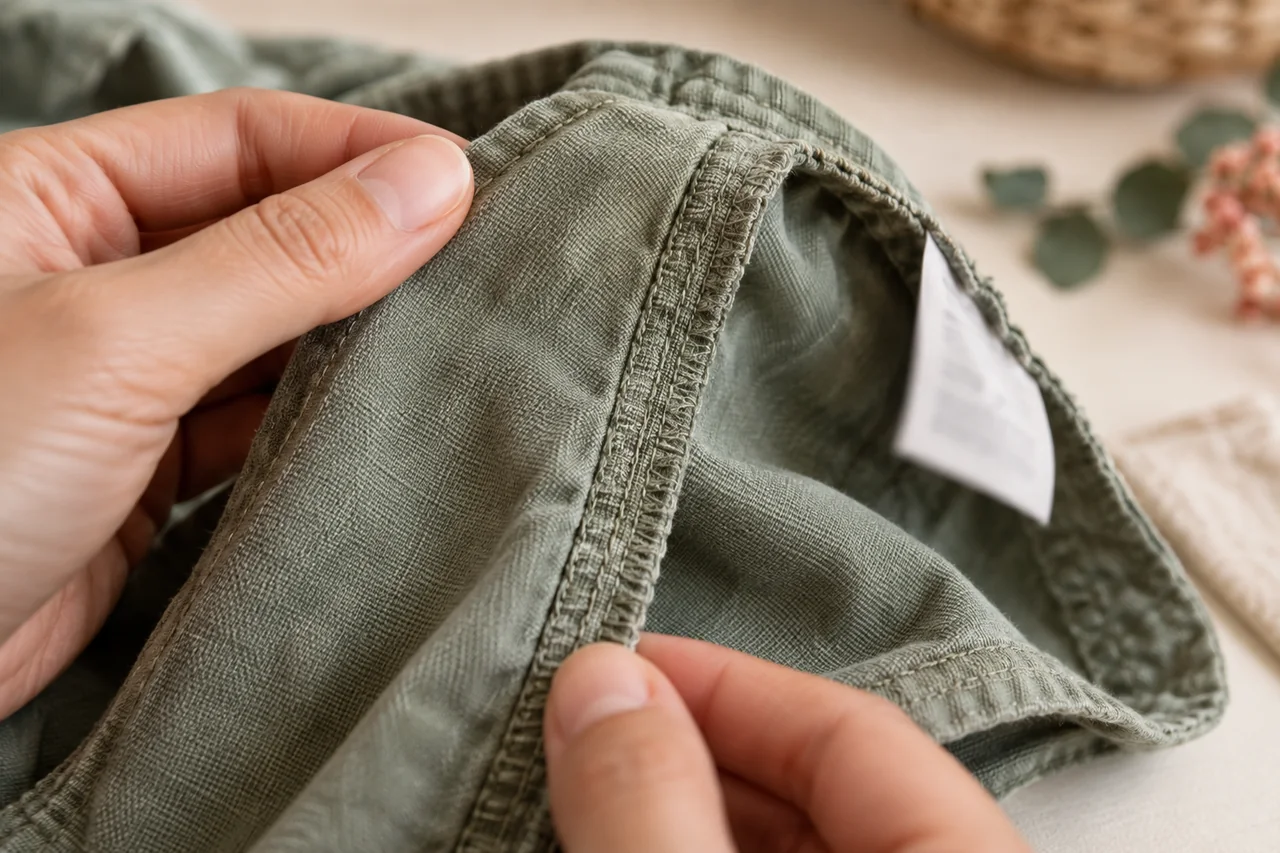
Permission to wash does not automatically include permission to tumble dry. Read the entire care sequence before treating a garment, then check unfamiliar symbols against an official guide rather than guessing from a similar shape.
Recognise the five groups
The washtub concerns washing, the triangle bleaching, the square drying, the iron ironing and the circle professional textile care. GINETEX explains the variants. Set an unfamiliar piece aside rather than adding it to a load based only on its colour.
Read the small differences
A number in the tub gives a maximum washing temperature. Bars beneath require gentler mechanical treatment, with two indicating a very mild process. A crossed-out symbol prohibits that treatment. Dots and other marks refine methods; use current official explanations and written notes. Photograph small symbols if needed.
Make a complete household plan
Match the label to your machine manual, including programme and permitted load. Decide where the item will dry before starting. If appropriate drying space is unavailable, delaying the wash may be better than improvising afterwards. Include timely removal and suitable storage.
Resolve missing information
Look for the exact model or ask the manufacturer. Second-hand listing details must match the actual garment. A textile-care professional can advise on uncertain construction. Before removing an irritating label, photograph care, composition and model information together with the garment for identification.
Frequently asked questions
Must I always use the maximum temperature?
No. It is an upper limit, not an instruction to use it every time. Soiling, programme and any specific hygiene needs also matter; do not exceed the garment’s limit.
Is fibre composition enough?
No. Linings, interfacing, colours, prints and trims affect the finished piece, so similar compositions can require different treatment.



Questions and experiences
Share a question or a useful experience about this topic. Every contribution is checked before publication. Comments may be written in different languages.
Loading reader contributions…
Opening the form sets a necessary session cookie. No email address is required. Publication is subject to moderation and is not guaranteed. For deletion requests: Contact